
Memento Vivere
Illuminating the Facts About Behavioral Health and Rising Above the Stigma
The Words We Choose to Use in Behavioral Health

September is National Recovery Month, and while I have not been directly impacted by what is referred to as a substance use disorder, many people that I know personally have or still are struggling. Mental health conditions and substance use disorders may not be exactly the same thing, but often times they are co-occurring, meaning they can be existing at the same time and one often leads to the other.
Here are the four main categories of substances that commonly cause dependency and some examples:
- Analgesics (narcotics/painkillers)
- Natural (Opiate) examples:
- Codeine
- Heroin
- Morphine
- Opium
- Synthesized/Synthetic (Opioid) examples:
- Carfentanyl
- Dextromethorphan
- Dextropropoxyphene
- Fentanyl
- Hydrocodone
- Hydromorphone
- Loperamide
- Meperidine
- Methadone
- Oxycodone
- Oxymorphone
- Natural (Opiate) examples:
- Depressants
- Barbiturates
- Benzodiazepines
- Nicotine
- Stimulants
- Amphetamines
- Caffeine
- Cocaine
- Ecstasy
- Sugar
- Hallucinogens
- Cannabis (THC)
- Ketamine
- LSD
- Psilocybin
When we talk about substance use we often think of illicit natural (opiate) painkillers like heroin or stimulants like cocaine, but other controlled substances cause dependency when not used as directed, these commonly include prescription opioids like fentanyl, oxycodone, or morphine, as well as prescription stimulants like amphetamines.
What we don’t often think about are depressants like alcohol and nicotine, or stimulants like sugar and caffeine. Even though these substances are legal to use, and products like alcohol, sugar, and caffeine are generally viewed as safe, they also have a profound effect on our bodies and minds with long-term consumption, and for many people are addictive and cause dependency.
The sensation you get when you haven’t had your morning cup of coffee, or you haven’t had your mid-afternoon sweets, or your hourly dose of nicotine, is a form of withdraw. While sugar and caffeine may produce a lower grade of withdraw than nicotine or alcohol, all of them train your brain to become dependent upon the chemical reaction caused by the substance.
While it’s generally easy to reduce the consumption of sugar and caffeine, most people will struggle to ever eliminate the use of these substances completely. Similarly, nicotine can be very challenging to eliminate when someone has become dependent. For more addictive substances like heroine, cocaine, and crystal meth, eliminating their use can be an overwhelming battle.
Alcohol, caffeine, marijuana, nicotine, and sugar have been a part of human culture for a very long time and have become a staple of the human experience for a sizable portion of the population. However, these reasons should not dismiss the negatives of their consumption or use.
When we have conversations about substance use, especially with people who are struggling, we need to be mindful of the language we use. Terms like “abuser”, “addict”, “druggie”, “drunkard”, and “junkie” are no longer acceptable. Terminology like this is derogatory, causes conflict, and labels the person as the disorder and not as a human being, none of which is helpful for someone experiencing addiction.
People are more than the conditions they battle with. We often forget this when we encounter them under the influence. Someone who may be violent when consuming alcohol, or someone who commits theft when seeking funds to purchase their substance of dependency, can be extremely difficult to see as a victim of their disorder. So it can be hard to stop labeling people with burdens as the burden itself, but if we ever hope to assist the person into recovery then words of support must replace words of judgment.
I used to speak about this during one of my classes, it’s so fundamentally important that we pay attention to the words we choose to use when referring to people. Not just those with substance use disorders but those with mental health conditions as well.
While I wouldn’t encourage them to do so, it’s okay for someone with a substance use disorder to refer to themselves as an “addict” or “drug abuser,” if that’s the terminology they choose to use. But it is not okay for someone else without a substance use disorder to refer to them in this way.
The same goes for people with mental health conditions. I often call myself “crazy,” due to my bipolar disorder, but this is not an invitation for others who have no lived-experience with a mental health condition to refer to me as “crazy” or as a “crazy person.”
You may be wondering why we use these words to describe ourselves if outsiders are deterred from doing so. I can’t speak for everyone as I think each person has their own justification, but for me it’s like taking back the power taken from me. Claiming a word for myself that is often used as a weapon against people like me feels as though it saturates its potency and makes it mine, rather than theirs.
Aside from avoiding derogatory terms like “addict” and “crazy” we should also not refer to people as their condition or disorder because they are not one in the same. I used to mention this in my class as well, we want to make sure that we are not confusing a human being with a mental health condition or substance use disorder, they are two very different things.
It’s not okay to use phrases like “heroine junkie” or “meth-head,” when referring to someone with these specific substance use disorders. The same goes for mental health conditions like schizophrenia and bipolar disorder. It’s not okay to refer to people with these conditions as “schizos” or to use phrases like “she’s bipolar.” Perhaps the worst of all is to refer to someone with a disorder or condition as a “burden.”
We have to remember that these are human beings struggling with substance use or mental illness. We are more than our substance use and mental illness, we struggle with those things but we are not those things. We have a burden, but we are not the burden. We are more than the burdens we carry on our shoulders, we are more than our struggles.
Think about it, do you really go around and refer to people with infertility issues as “infertiles” or “sterile people” as if they are somehow not other human beings deserving of equal compassion? No, of course not. Their condition does not rob them of their humanity, so why would we rob anyone else struggling with a condition or disorder of theirs?
Proper terminology is to say “He has schizophrenia” or “She has bipolar disorder.” Stating that someone has a disorder or condition separates their identity from the things they struggle with and allows them to maintain a degree of dignity and humanity, allowing us to treat everyone as the fellow human beings they really are.
It’s true that substance use and mental illness can morph people into individuals we no longer recognize, dramatically altering their behavior and in some cases physically changing their appearance, but no matter how bad it gets, they do not cease to be human, they do not cease to be your family member, friend, colleague, or neighbor, and it’s at those lowest points when they need you the most and your willingness to treat them humanely.
If you or someone you know is experiencing a mental health or substance use crisis, please access my immediate assistance resource page. A comprehensive listing of online and phone resources and services is also available.
In Memoriam: Ricardo “Ricky” Reyes

My dear friend Ricardo “Ricky” Reyes of Mount Joy, Pennsylvania, passed away tragically on August 20, 2022. He was born on June 21, 1987 and grew up in Lancaster, Pennsylvania, the son of Iris Gomez Lopez and the late Salvador Reyes. He graduated from Lancaster Catholic High School in 2005 and enlisted as a reservist in the United States Marine Corps. He served as a Field Artillery Cannoneer with India Battery, 3rd Battalion, 14th Marine Regiment, 4th Marine Division out of Allentown, Pennsylvania, from November 2005 to February 2012. He was deployed from September 2006 to April 2007 in support of Operation Iraqi Freedom attached to [2d LAAD Battalion? – pending confirmation]. He was also deployed to Africa from May 2011 to June 2011. He was a 2012 graduate of Thaddeus Stevens College of Technology in Lancaster, Pennsylvania, with an associate degree in Collision Repair Technology.
I met Ricardo, or “Ricky” as most people knew him, online in 2006 sometime before or during his deployment. I can no longer remember exactly when or where, it may have been on Xanga or MySpace or potentially on Military.com’s forums as I spent a lot of time on there due to being interested in enlisting. Wherever it was, I remember us messaging one another, initially about the Marine Corps and other military related stuff. From those conversations we grew to become friends and exchanged phone numbers and followed one another on social media for the next sixteen years. He supported me both before and after my enlistment in the Marine Corps in 2007, for a while I considered him one of my closest friends that I could confide in with anything because I trusted, admired, and respected him immensely, I was and still am grateful for his long-lasting and loyal friendship.
He was there for me when I was going through mental health struggles resulting from my premature discharge in 2008. Even when he was busy he still responded to me, any time of day or night. I had not spoken to him as much in more recent years, that’s just how life goes, but I knew that no matter how much time had passed he would treat me exactly the same way as he always did, with open arms and as supportive as ever. Whether it was personal life stuff or car stuff, I knew I could reach out to him for advice. I last spoke to him a few months before his death. A person will never meet someone more loving, supportive, and accepting. The world has suffered a great loss and I am devastated by his passing.
My condolences go out to his family and other friends, of which he had many! He was loved, adored, and admired by so many people, a testament to his character and the type of man he was. I don’t understand how or why the accident happened, but I feel like he would tell me that he died doing something that he loved. He always told me to live without regrets because he tried to live his life that way too.
To anyone who did not know him, I would paint him as a man who served his country with honor and pride, who cared deeply for his family and friends and would do anything for them, he lived to the fullest whether that was traveling, or concerts, or social gatherings, he was always doing something as he hated being idle, and the only thing he loved more than cats were cars and his bike, oh and his loyal “Yota”, he loved that thing too. I never knew him to be angry or bitter, he was always warm and supportive for the entire sixteen years I knew him. He was friendly to everyone he met.
On August 28, 2022, I drove from Missouri to Manheim, Pennsylvania to attend his memorial service on the following day. There are very few people in my life that I had been friends with and had sustained communication with as long as this man, I knew that if I didn’t go I would regret it for the rest of my life. I had hoped that by driving all the way out there and paying my last respects it would allow me to better process my grief over his passing. I also made the decision to go to the location where he died, more about that in a bit. He has since been laid to rest at Indiantown Gap National Cemetery, I will be returning to visit him again.
I was touched by just how many people from Ricky’s life were at his memorial service, such a powerful message for how much he was loved, admired, and respected. I am grateful to have had the opportunity to meet his mom and listen to his family, military family, childhood friends, and other friends tell stories of how he impacted their lives and the funny memories they had of him. Hearing those stories helped paint a picture for me of who he was in other people’s lives, illuminating facets of his character and history that I did not know. To me, this was a gift and I will cherish it. I know that many others have similar stories to tell, though some of us found it too painful to share openly at his memorial service.
In 2021, I had planned to travel to Acadia National Park in Maine and my hope was to stop in Pennsylvania and spend time with him. However, due to pandemic-related complications and my unemployment at the time I made the decision to delay that trip. Reflecting on how I felt during his memorial service, I found that I had some degree of guilt over that decision. Of course I could have never known what the future would hold and so I don’t blame myself for that decision, but that doesn’t mean I don’t have guilt and regret about it. I think that others in his life may have a similar sense of guilt or regret about not reaching out to him more or not spending enough time with him, and considering the circumstances of his unexpected passing I feel like this is a very natural thing to feel.
These last few days I have been scrolling through his social media posts, searching through my own social media feeds looking for posts and comments he made, going through my phone and reading our last private messages, and mentally kicking myself for having not saved our older communications when I changed phones over the years, especially those conversations from 2006 to 2012 when we communicated the most. I didn’t know back then that those conversations would one day hold a whole lot more meaning to me. What I do have left are conversations with him asking me if I put a hood scoop on my Avenger yet, and our most recent conversation wherein he was very convincingly encouraging me to buy a Toyota Tacoma, or a “Taco” as he referred to them. Those conversations may have been generic or basic at the time, but wow do they mean so much more to me now.
In 2016, my mom died after a long illness. I also lost another friend, Colin, just a month before that, very unexpectedly. While I had the opportunity to say my last words to my mom, I did not have the opportunity to make peace with Colin. After those losses, I reached out to Ricky and told him what I really thought about him, essentially my feelings toward who he was as a person and a friend. I am so immensely grateful that I had taken that opportunity. The knowledge that he died knowing how much I really appreciated him brings me a lot of comfort and peace. The shock and pain of his passing is by no means diminished, but it means so much to me that he knew how I felt about him.
As I mentioned at the beginning, I drove to the intersection where the motorcycle accident happened. I don’t know why but I needed to see it as part of my grieving process, to be there in the place of his last moments. There was some kind of work being done at the location, so I couldn’t stop and walk around as I had planned to do, but I could certainly see how an accident could happen there.
Loss is always hard, whether expected or not. It truly is like a wound that hurts immensely at first, drains so much joy and vitality out of you, and it never fully heals because it always leaves a scar that at times will ache as if to remind you of what you have lost. Though the scar fades and hurts less in time it still remains there forever, an aching emptiness to remind you of that person who was once a part of your life but is no more.
I think perhaps there are lessons to be learned here, I feel that we should reach out more to the people in our lives and let them know how much they mean to us, you never know when they may be taken from you. I have lost so many people in the last six years that at times I feel dumbfounded by the whirlwind of shock and grief.
Some say you can fill that void of loss, but I have never found that to be true. Remembering the moments that you shared helps immensely, though it can also resurrect the grief and pain of the loss. I have found that creating new memories by doing things that remind me of the person or engaging in things that they enjoyed can help me feel close to them again without focusing too much on “what used to be” or what I have lost.
It’s not the same as if they were literally there, but in some strange way making new memories doing these things makes me feel as though they are with me. I intend to do this for Ricky as well, it won’t be hard for me because there are reminders of him everywhere I go. I cannot comprehend a life and a world without the privilege of knowing that he’s just a quick message away.
Pour one out for this man, if anyone deserved the title of legend, it’s him. I’d say “rest in peace” but that’s not the man I knew, he wasn’t interested in resting, so maybe “ride free” or “stay wild” or “fly high” would be more appropriate. He was and still is loved and will never be forgotten!
Music & Mental Health: A Path to Recovery

It was the spring of 2021 when I was first introduced to Oliver Daldry‘s music via a U.K. 2015 film titled Departure. At the time, I had quit my job a couple months prior and I was in a low point mentally, struggling with anxiety, depression, and was experiencing suicidal thoughts. For a few months, every day was a battle.
When I went on YouTube to see if I could find more of his music I found a song titled Bookcase, and when this song played for the first time it was late at night, my whole apartment was cast in darkness except for the glow from my laptop screen. The intro of the song stunned me, like suddenly having tunnel vision except for my ears, and as the song played I felt as though I was falling or perhaps being swallowed into a dream, somehow transported outside of time and space.
Every lyric of the song reached out and into me like fingertips touching my heart. It simultaneously hurt and felt loving, like washing away the blood from a wound that has not yet healed, like a harsh truth I needed to hear if I had ever hoped to recover.
I sat there on my apartment floor crying quietly as the song played out, it was like some kind of spiritual experience for me.
Needless to say, I bought the song and I’ve probably heard it a million times since then. It’s not as potent as it was the first time I heard it, but songs are always like that, it can never be like the first time you heard it. It still reminds me of that hard time in my life, but it also reminds me of how I recovered after and right now I need that.
Like I said it’s been over a year now and I am once again unemployed, having quit my job a month ago after situations there interfered with my mental health. I come back to Oliver’s music when I need to hurt and heal, because you can’t have one without the other.
I’ve bought every song I can find of his. Catch the Wind, Diamond Sky, Howling Wind, are some of my other favorites, but every song has a meaning and a message, it’s up to the listener to decipher it for themselves.
The songs are personal to Oliver, and they are personal to me the listener, but that doesn’t require the meaning to be the same. That’s what’s great about songwriters, they help us understand our own emotions without even knowing what our emotions are and yet somehow we have this shared experience and it’s extraordinary.
Oliver is incredible, not perfect, but incredible. His songs are like the mortar for bricks, they are not the thing itself but the stuff that holds the thing together.
His songs are like his scars, remnants of something that was, things with meaning and history, and when he releases a song it’s like he’s revealing a scar to us and while we may not know the story behind the scar we can still relate to it because we have scars too.
He is not merely an artist to listen to, he is an experience to be had. I am grateful to be alive in a time graced with the music of Oliver Daldry.
If you or someone you know is experiencing a mental health or substance use crisis, please access my immediate assistance resource page. A comprehensive listing of online and phone resources and services is also available.
Unbecoming: The Struggle for Acceptance
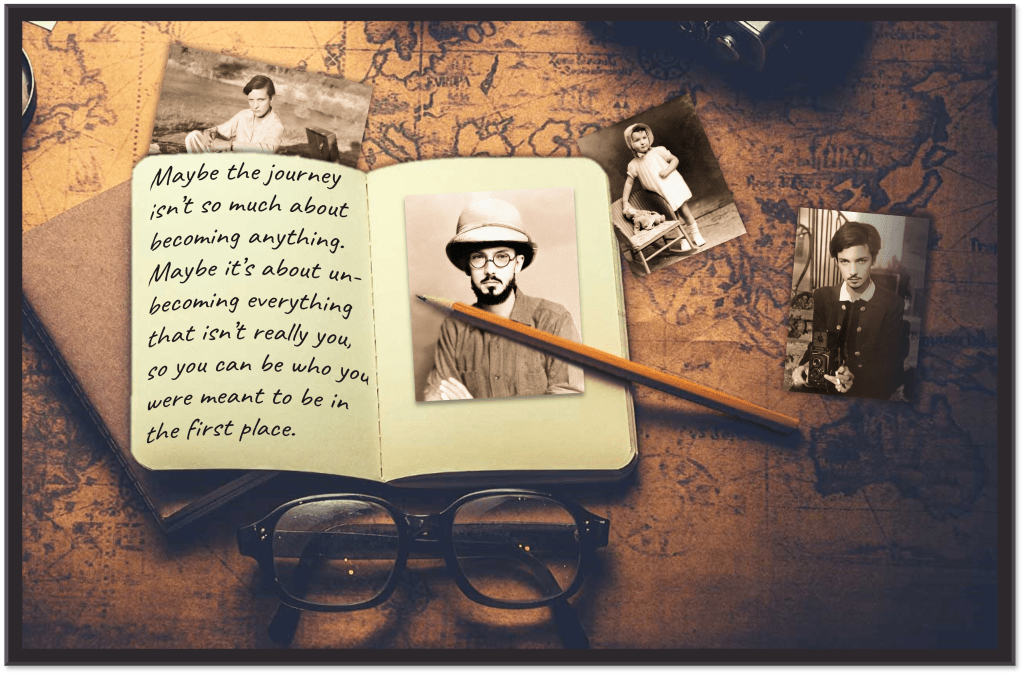
Unbecoming:
The Struggle for Acceptance
I didn’t know anything about the trans community a decade or so ago, and honestly I felt no concern whatsoever over trans people or their rights because I didn’t think it had anything to do with me, my perception was that I couldn’t remotely relate to anything they were experiencing. All of that changed when I met two trans youths and actually had an open conversation with them. They helped me understand what they had gone through and what they were still going through.
There are people I respect and agree with on many social and political issues, but who are completely wrong about trans rights because they take absolutely no opportunity to have an open and honest conversation with someone who actually is transgender, which makes it so incredibly hard to continue to feel any degree of respect for them. I hold out the hope that in time and with empathy they can and will reach out to someone who is transgender for a conversation and undergo a change in perspective, just as I did.
If someone is unwilling to accept that this is about human dignity and not just a political issue, then they’re woefully misguided. It is very frustrating to encounter so many people who do not attempt to understand the trans community and instead choose the path of belittling and harassment. They do not understand them and so they have fear and that fear causes them to have awful opinions and make hurtful decisions. They stop seeing them as human and see them as objects to ridicule, they forego all opportunities to practice empathy. Sometimes this outward hatred is actually a product of their own internal self-hatred.
As someone who has long been involved in behavioral health, it is overwhelming to know how many trans youth are still struggling right now with a society that not only invalidates their identity, but that invalidates their very right to have the identity they know themselves to be. While I do not know what it’s like to feel as though I’ve been born into the wrong body, I absolutely know what it’s like to battle with myself while in the midst of a society that does not accept some aspect of who I am. This is a shared struggle.
The silencing of the trans community and the denial of access to mental and physical health care is outrageous and appalling to me. One does not have to be trans to find these things disturbing, for human decency and the earnest desire to understand another person is all that is required. All those years ago those two trans youths helped me to see that we were not so different, my conversations with them helped me see our shared humanity and in-so-doing, our shared struggle.
The reality is that right now as I write this there are trans youth reading through social media posts and comment threads filled with hateful and dehumanizing language, with discrimination and harassment. Young people who are already facing an immense internal battle with self-acceptance, who are statistically very likely already experiencing suicidal thoughts and behavior.
They suffer ever the more by being exposed, often blatantly and forcefully, to people with a lack of dignity and integrity, a lack of self-control and self-awareness, who openly and aggressively express their cruelty, heartlessness, and chosen ignorance without any regard for the consequences of their words and actions on these struggling, traumatized, impressionable, and innocent youth.
If you or someone you know is experiencing a mental health or substance use crisis, please access my immediate assistance resource page. A comprehensive listing of online and phone resources and services is also available.
The National Suicide Hotline Designation Act: 988 Takes Effect July 16, 2022
The National Suicide Hotline Designation Act was signed into law on October 17, 2020 and as of July 16, 2022, will go into effect. This means that starting on that date anyone in the U.S. experiencing a behavioral health crisis can call or send a text message to 988 instead of the previous National Suicide Prevention Lifeline number 1-800-273-8255.
The services received will be the same as before, when you call or text 988 you will still be routed or connected to the nearest Access Crisis Intervention center for your region of the state. For example, if you live in Osage or Cole counties in Missouri you will be connected to a crisis counselor at Compass Health Network’s call center. All of these centers in Missouri and in the other states operate 24/7, all calls and texts are free and conversations are confidential.
The main purpose behind the law was to ensure that an easy to remember number was established and that effective behavioral health crisis response services were developed nationwide. The implementation of this new three-digit number should reduce the amount of calls being made to 911 dispatch that do not correlate with medical emergencies, reducing the occurrences where law enforcement and fire rescue personnel are dispatched to non-medical emergency situations.
Anyone experiencing suicidal thoughts or behavior, struggling with the symptoms of a mental health condition or substance use disorder, or anyone in emotional duress can contact 988 by calling or texting. If necessary, the Access Crisis Intervention centers are also supposed to be equipped with specialized teams of responders who can physically go to the callers/texters location to provide behavioral health aid.
However, this service does not replace law enforcement, fire rescue, or EMT first responders, and so any situation involving imminent risk of harm or death, such as a suicide attempt or overdose having already occurred where someone ingested/injected something or physically harmed themselves or others, should contact 911 as that is a medical emergency and not solely a mental health crisis.
There are urgent realities driving the need for crisis service transformation across our country. Per the CDC, in 2020 alone, the U.S. had one death by suicide about every 11 minutes. For people aged 10 – 34 years, suicide is a leading cause of death. From April 2020 to 2021, over 100,000 individuals died from substance use overdoses.
According to Mental Health America, we have not seen suicide rates this high since the 1940’s. They report that at least 2.5 million American youth have some form of severe depression. Suicide rates are highest among Indigenous peoples of America and white/Caucasian populations. Per population, suicide occurs more frequently in rural and suburban areas than urban populations, and suicide rates are also disproportionately high for those who identify as LGBTQ+.
According to the Substance Abuse and Mental Health Services Administration and the National Institutes of Health, 1 in 5 Americans is currently struggling with a mental health condition or substance use disorder, 45% of Americans will develop a mental health condition or substance use disorder at some point in their lifetime, and more than half of those developed symptoms by the age of 14 and have not sought (and are statistically unlikely to seek) professional treatment for their condition or disorder.
With 31 million Americans struggling with a mental health condition, 19 million Americans struggling with a substance use disorder, 11 million Americans experiencing suicidal thoughts, and all at this very moment, the need for crisis intervention and support services is high.
The unfortunate reality is that the whole behavioral health industry is understaffed, not effectively equipped, and are underfunded. The amount of turnover, burnout, and compassion fatigue experienced by those in this industry is high. According to the Missouri Department of Mental Health, about half of all Missouri college graduates in the field of behavioral health leave their industry jobs by the end of their first year of employment.
For those struggling and those who are assisting or supporting those who are struggling, the need for expanded services and funding is right now. There are state and federal funding initiatives supporting the 988 lifeline, but more needs to be done to ensure this crisis intervention service continues to be effective in the longterm for all of our communities. Several states in the U.S. have added a small fee to telecommunications services to help fund the 988 lifeline, Missouri needs to be one of those states.
For information from the Missouri Department of Mental Health: https://dmh.mo.gov/behavioral-health/988-suicide-and-crisis-lifeline
For information from the Substance Abuse and Mental Health Services Administration: https://www.samhsa.gov/find-help/988/faqs#about-988
Long December
Long December
Another long December has come again, another year of trying to forget the way you made me feel, another year of trying to forgive myself for what I let happen, another year of searching for ways to finally heal.
Another long December of regretting the night we laid in a hotel bed, you left me there alone but the memories still persevere, I knew I’d never see you again from the sinking feeling of dread, as you walked to the door so cavalier.
Another long December of remembering how I fell to the floor from the words she said, it was Christmas Eve and you asked your ex-fiance to break-up with me on your behalf, as you didn’t have the courage to say it to me yourself instead, an act so true to your nature of being cowardice riffraff.
Another long December of hating you and hating myself more, I haven’t dated another person since you left me 8 years ago, when I watched you walk out of that fucking door, not knowing how bitter I’d become or how cold I’d grow.
Another long December and I’m still emotionally vacant, another year of not letting anyone get past my wall, my heart may still be there but my love is latent, I just can’t bring myself to trust anyone at all.
Another long December of wondering where at night you rest, lingering thoughts of how much more time in jail you’ve spent, or if there’s still a warrant out for your arrest, or if your daughter even remembers that you’re still her parent.
Another long December of seeing your face on everyone, of foolishly thinking you’ll find your way back to me, as if somehow seeing you again will undo what you’ve done, like we could just start over so easily.
Another long December of ghosts and sunsets, another year of an untouched pillow and a cold sheet, of hopelessness and unhealthy mindsets, longing for a place and a time where our hands could meet.
Another long December of wanting to believe that this time could be different, that this time I’d be the only one and there’d be no silence and secrecy, that your ex-fiance won’t get involved and be so belligerent, perhaps she’ll finally let go of you and her jealousy.
Another long December of constant delusional thought, of confusing who you were with who I wanted you to be, I need to stop being so hung-up and distraught, to find a way to finally let go and be free.
The Power of Purpose, Meaning, and Fulfillment

In my late teens and early twenties I knew what it meant to have a sense of purpose, but what I didn’t know was just how powerful its effect really was on my life. My discharge on January 11, 2008, was the first day of a new life where I had no purpose or meaning, and thus any potential sense of fulfillment felt impossible to attain.
I struggled a lot in the years since then, trying to find a new sense of direction. Through this experience I have learned that goals are the essence of purpose, the product of meaning, and eventual source of fulfillment. They empower us to push through when we face obstacles and setbacks in life. Goals that challenge us also make us stronger when we have the support we need to achieve success.
When you feel lost in life, it’s because you’re not striving towards anything. In behavioral health recovery, we talk about the importance of establishing and working towards attainable goals because it’s an essential process to living a better life. Goals are the threshold of a self-directed life.
A life without a goal is like a ship without a rudder, sure you may be tossed about here or there by the current or the waves or may even be caught up by the wind in your sails but in all of those scenarios you are at the mercy of the elements. Maybe they will take you somewhere great or maybe they will lead you to disaster, either way you are not making decisions for yourself about the direction of your own life. The core of recovery is to take back control, to regain a sense of self-determination.
Whether you’re still a teenager or you’re retired from your career, a goal can carry you through the hardships brought about in every stage of life. But it’s important to understand that any goal you may choose, must be yours alone, it cannot be given to you by anyone else. It must be personal, it must be self-directed.
You have to believe in the goal if you ever hope to believe in your ability to achieve it. You have to feel it, hear the calling, and hunger for its embrace. Only then will it ever matter to you and only then will it ever give you the strength you need to find your way through the darkness that is the human experience.
Over the years I have developed something of a triage model for evaluating my life. For me, this model has been the guiding compass of my life since my discharge and I have continuously come back to it when I have begun to feel lost. It includes: purpose, meaning, and fulfillment. This article will cover these three factors and how they impact our lives in profound ways. In these first few paragraphs I want to give a brief introduction to all three and then give a thorough exploration of the methods and tools you can implement to help you identify your own sense of purpose, meaning, and fulfillment so that you can live the best life possible.
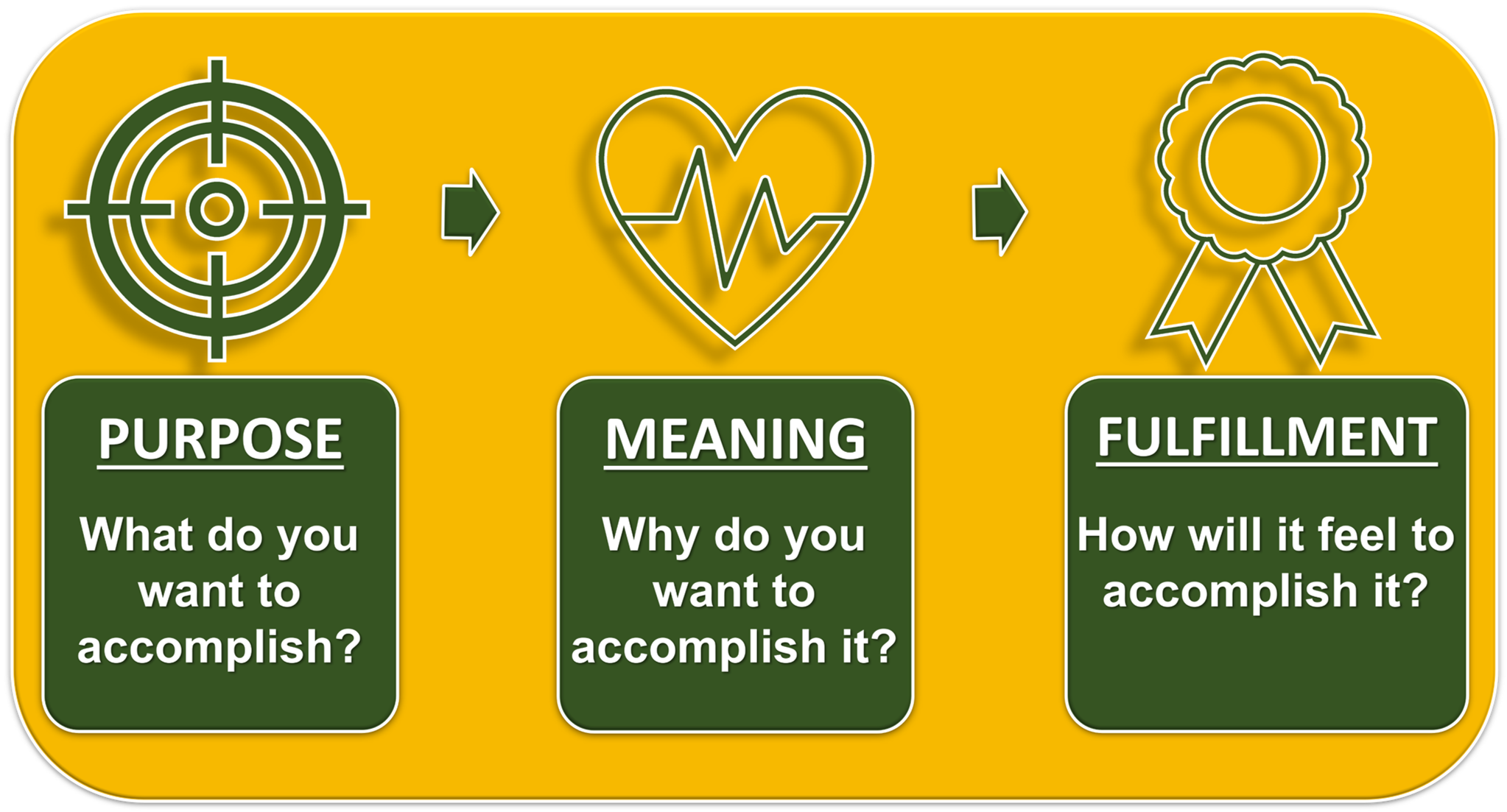
Our purpose is the collection of dreams, goals, and intentions that we set for ourselves. Our meaning is the sense of yearning or justification that we feel about those goals and ambitions, and our fulfillment emerges from the sense of satisfaction we get upon completing them. Meaning is what drives purpose because we yearn for things long before we ever understand why. You will know your goals long before you know the deep “why” behind your desire to accomplish them. Think of it this way, you may choose to go on a journey (purpose) and you may give yourself all kinds of reasons, but the true justification (meaning) will not come clear to you until you are on that journey and experiencing its hardships. If you complete that journey and find success, then you will know fulfillment, for fulfillment will only come at the end of struggle.
For example, I knew that I wanted to enlist in the United States Marine Corps, but I honestly didn’t truly know why, I just knew that I wanted to accomplish that dream. I had several reasons I gave myself and other people, but those were surface-level explanations, they weren’t the deeply held “why” that I didn’t yet fully understand. It took me a really long time to know why I wanted it so badly, to learn the meaning behind it all. I think a lot of things in life are exactly like that, particularly the big choices that we make in the various stages we go through. Think about it, how many times have you asked someone why they did something only to receive the response, “I don’t know.”
Meaning will always remain indescribable until you have begun the process and have set out in pursuit of your goal. Meaning drives purpose by calling to you in the distance, begging you to take action, but it remains hidden and obscure until you have chosen to take action and pursue your goal (purpose). You will likely give yourself all kinds of reasons as to why you want to chase after a dream, but those reasons are all false, true meaning can only be revealed during the pursuit itself.
A more concise explanation of my model would be this:
Sometimes I come across people who will roll their eyes upon hearing the word “goal.” For these individuals it summons to mind images of pushy parents, eager teachers, micromanaging bosses, life coaches, new age gurus, multi-level marketing schemers, or perhaps even those ‘law of attraction’ peddlers.
It’s unfortunate that people use the core principles of strife and success as tools to enrich and empower themselves at the expense of people who are struggling. But you don’t need to pay hundreds or thousands of dollars to learn how to use the power of purpose, meaning, and fulfillment for yourself. All you need is a sense of longing, the curiosity to ask why, and the courage to take the first step. Though, I do caution that it will be the scariest step you will ever take and it is likely that you will initially find failure upon the path, but if your tenacity has been forged in the fires of deep desire then you will not wallow in your despair but rise to face adversity.
Theodore Roosevelt perhaps said it best in his famous speech, “The Strenuous Life”:
“…I wish to preach, not the doctrine of ignoble ease, but the doctrine of the strenuous life, the life of toil and effort, of labor and strife; to preach that highest form of success which comes, not to the man who desires mere easy peace, but to the man who does not shrink from danger, from hardship, or from bitter toil, and who out of these wins the splendid ultimate triumph…
It is hard to fail, but it is worse never to have tried to succeed. In this life we get nothing save by effort… A mere life of ease is not in the end a very satisfactory life, and, above all, it is a life which ultimately unfits those who follow it for serious work in the world…
Far better it is to dare mighty things, to win glorious triumphs, even though checkered by failure, than to take rank with those poor spirits who neither enjoy much nor suffer much, because they live in the gray twilight that knows not victory nor defeat.”
~ Theodore Roosevelt, April 10, 1899, Chicago, Illinois

The goal itself can be anything, it doesn’t even have to be life-changing. Instead of reinventing your life, maybe you just want to remodel the kitchen? Instead of restarting your career, maybe you want to learn basic survival skills? My point is the goal you pursue can literally be anything as long as it presents a challenge. Without that it’s not worth pursuing. Nothing in life worth anything ever comes easy and the greater the challenge the more rewarding the eventual success.
Part One: Resiliency
Through this process of seeking challenges to overcome you are developing what’s known as active resiliency. By it’s very nature, resilience simply means that the more you encounter or experience something that challenges you and overcome it, the less negatively impacted you will be if you encounter or experience it again in the future. Active resiliency is not merely something you have, it is something that you do.
There is also a type of resiliency known as inactive. This type of resiliency is discovered through no intention of your own. These are the types of unexpected and unplanned-for scenarios in our lives that seem to come out of nowhere. For example, your health suddenly declines, your vehicle breaks down, your romantic partner cheats on you, your employer decides to terminate you for budgetary reasons, the list goes on and on. When challenged, your ability to not give up because of them or not be sidetracked or defeated by them, allows your resiliency to grow.
In the face of either type of adversity (active or inactive) you have two options: you can either engage with it and try to overcome the setback or obstacle, or you can choose to disengage and do nothing. The potential outcomes to engaging or disengaging are either gain or loss. Choosing to disengage with a challenge may initially feel like relief, safety, or even stability with the immediate reduction in anxiety, but it could also be demoralizing and regretful overtime. You must have the wisdom to know when to engage or disengage with the situation.
For example, perhaps you want a pay-increase but you are too fearful to ask for it, or too hesitant to take on the additional work to prove your value in the workplace. Avoidance of the challenge in this situation will feel as though you’re avoiding short-term stress and anxiety, but it will eventually lead you to long-term regret. On the other hand, if you’re out hiking a trail and suddenly see a bull moose charging at you, it’s highly likely you’ll seek an alternative path and not experience long-term regret over disengaging with this short-term stress and anxiety-inducing challenge.
In the more universal situation of a pay-increase, when you choose to not engage with your employer in fear of potential rejection or because of anxiety, it’s more than just being lazy – the behavior is addictive and destructive. Quitting or taking the easy way out is so very seductive and the more you do it the more desirable it becomes and the more likely you will do it again in the future. You will essentially train your brain to avoid difficult situations by rewarding it with those short-term feel-good brain chemicals, causing it to become weak and less resilient. I know this from personal experience.
Disengaging is a choice we are making for ourselves, a choice we have the power to transform. Thankfully, when you choose active resiliency you are forcing yourself into challenging situations and the more you do this the easier it also becomes in the future. It’s the hard choices in life that are the most meaningful and the most rewarding in the long-term. Aside from anxiety-avoidance, one of the other reasons so many people choose to disengage is because they try to accomplish something huge right out of the gate. Doing too much, too quickly is a terrible mistake.
It’s important to note that I’m not talking about merely exposing yourself to difficult situations or challenging experiences and then running away and never returning to it. It’s not enough to just acknowledge the fear, you must also struggle with it and overcome it. For example, if you’re afraid of heights you might consider riding an elevator to the top floor of a high-rise building. This is a good first step, but it should never be your last step. Progress further by looking out the window or over the edge the next time. Eventually your goal should be bungee-jumping or sky-diving. This practice is based on exposure therapy, what’s sometimes referred to as desensitization.
The goal is not to compete, but to win – there are no ‘participation trophies’ in adult life. Start small and push yourself to accomplish little objectives each day. Starting with major life changes will end in failure due to the enormous commitment required. Set goals that are achievable for you right now, based on your time, energy, abilities, and resources. Don’t overwhelm yourself and never set yourself up for failure. Build momentum by completing progressively bigger challenges and don’t ever be afraid to ask for help or to take time to rest and recharge so that you avoid burnout.
Too much, too fast is the enemy of many ambitious people. As of 2019, burnout has dramatically impacted so many people’s lives that it has been recognized by the World Health Organization as a mental health condition requiring treatment, and even though the American Psychiatric Association didn’t include the condition in their 5th Edition of the Diagnostic and Statistical Manual of Mental Disorders, published in 2013, they will likely follow suit and include it in a future publication.
Part Two: Setting a Goal
There are methods and models that you can follow to become better at setting attainable goals and actually following through with them. These tools have been around for decades and have been proven effective in clinical, non-clinical, and professional settings.
One of the big hurdles I’ve heard people say is “I don’t have a goal” or “I don’t know what I want to do.” I actually beg to differ, in fact, there’s always something you want to do if you just take the time to listen to your inner self. Somewhere in there you’ll hear a calling, a yearning to go and do something. You won’t understand it at first and that’s absolutely okay because the first thing we want to do is determine what kinds of things you feel a desire to do, we do not yet need justification.
Remember, “what” is the easy question, it’s the question we want to tackle first. The “why” is so much more challenging to figure out and should be considered your secondary step as it cannot be understood until you have already begun the pursuit. Potentially, spending time worrying about the “why” before taking action on the “what” is one of the worst mindsets to be in because you will just stand there, paralyzed with indecision, thinking and worrying. This demonstrates a trap of cyclic thinking that can easily turn into catastrophic thinking or even worse, learned helplessness. These states of mind must be avoided as much as possible.
So, the first obstacle to overcome is your purpose or identifying a clear goal. A model that can be used for this purpose is called Dissatisfaction Goal Setting, wherein you’re literally evaluating your life and determining if something feels unsatisfactory. This tool can not only help us identify a goal but also begin to bridge the distance between purpose and meaning.
Ask yourself these questions:
- What am I unhappy with?
- What do I not like about it?
- What would I rather be doing?
- What is keeping me from doing that?
- Who can support me in that goal?
- When do I want to start?
What you eventually identify by using the tool could be anything, there is no such thing as a wrong answer. This will be personal to you and your life and no one else can tell you what personal goal you should be setting for yourself. If someone attempts to do so, walk away from them – they don’t care about you, they care about manipulating you to do what they want or what they think would be best for you. A purpose-driven life is one lived by your own choices, not by the choices of others. You may ask for counsel or perspectives on the matter, but your path must be determined by you alone and walked by you. Though others may come along with you on the journey, they cannot lead you. Think of them as lanterns that you carry along with you, there to shine light into the darkness so that you may see possible paths, but only you must choose in which direction to travel.
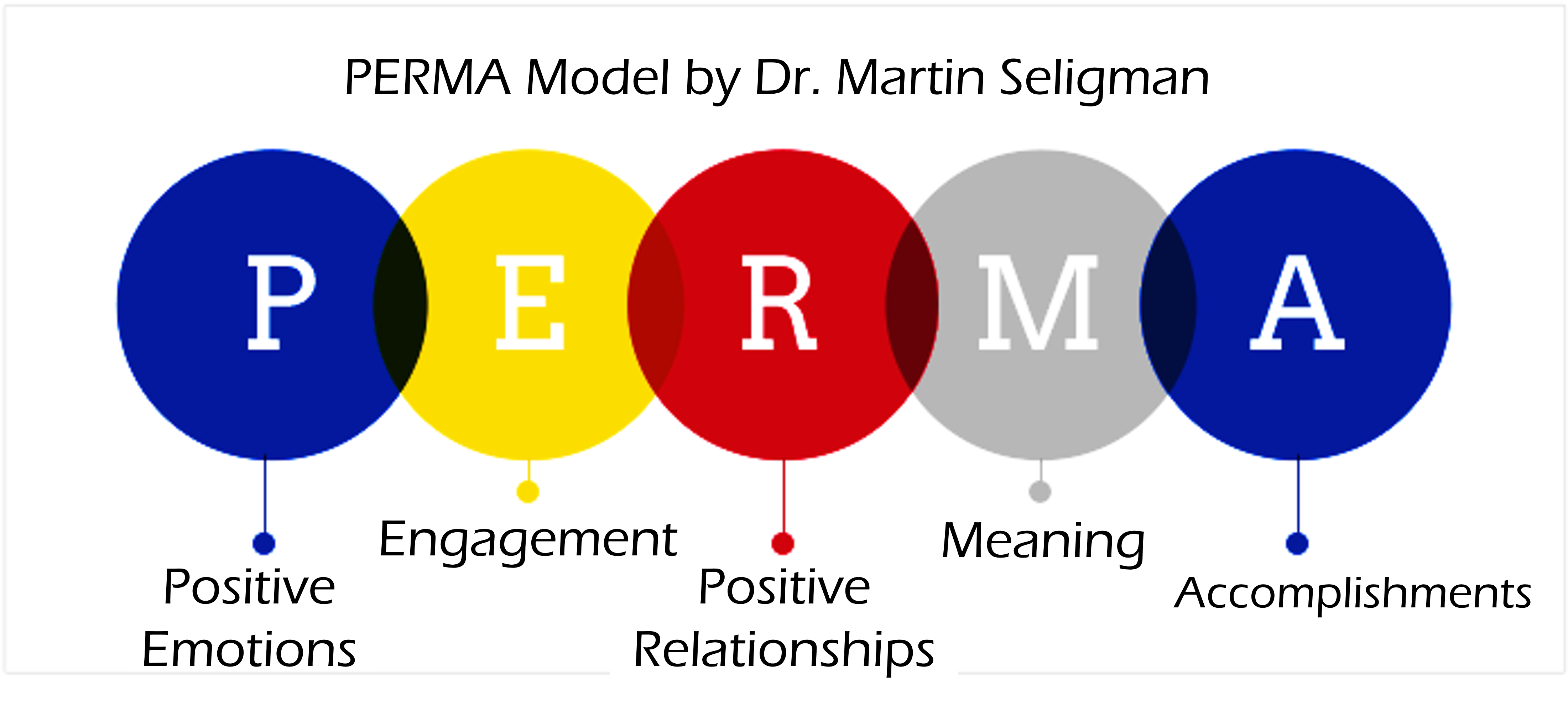
Another model that can be valuable in helping identify a goal is the P.E.R.M.A. Model, developed by American psychologist, Martin Seligman. This model sets out to define what makes life worth living, what elements or factors make us feel as though we are living a flourishing life. He identified positive emotions, engagement, relationships, meaning, and accomplishments as measurement markers in determining whether or not you are currently living a flourishing life. Using this model we can identify areas of your life where perhaps it’s underdeveloped or missing something.

Positive Emotions can encapsulate just about anything that gives you a sense of joy. Whether it’s spending time with your loved ones, baking your favorite cake, going to the comedy club, going bowling on the weekends, adopting a pet, watching your favorite team, attending theater, starting or raising a family, or taking an annual summer vacation to your favorite wilderness area. No matter what you enjoy doing or experiencing, it is essential that you make time for it in your life and allow yourself to be present in the moment so that the experience can provide you with the positivity you need.
Engagement takes your enjoyment one step further. This is about more than just having fun or enjoying a spectacle, this is about becoming enthralled by the experience, mind and body, so much so that you lose track of time and become fully engrossed. Athletes, musicians, artists, all typically have the potential for this type of experience, but just because you don’t play soccer or play the violin or have the talent to paint a mural, doesn’t mean you can’t also satisfy this element of a flourishing life. From rock climbing to gardening, and furniture building to cooking, so many things can count as long as it requires mental focus and physical dedication and interaction.
Relationships are integral in the lives of pretty much everyone. Many of us strive for the social benefits of human interaction and crave the attention of someone who cares for us. While family is often the stereotypical go-to for relationships, it doesn’t have to be the sole source. We can find deep and meaningful connections with our friends – the family we choose. Whatever your circumstance, we all need at least one person who can be there for us at any time, for any situation, without judgment and with unconditional love and support.
Meaning is so critical because it keeps you going when everything is overwhelming, not just during the pursuit of a goal but throughout your whole life. Whatever you choose to do, you must make certain that either your professional life or your personal life is providing you with a sense of meaning. Many people look to spirituality to satisfy their meaning, but it doesn’t have to be that – you can also find meaning in advocacy and volunteering or even in parenting, anything that puts you into a situation of serving something larger than yourself. Like everything else I’ve discussed, it cannot be given to you, it must be self-determined – you must feel summoned to it if you ever hope to achieve meaning. Remember, meaning is derived from the doing and not the conclusion, or in other words it comes from the pursuit of a goal and not from its achievement.
Accomplishment is separate from meaning in this model for a reason, they are not the same. Fulfillment is the offspring of purpose and meaning, it is the product at the end of your journey. If you have strategized and prepared, planned and organized, then in time you will know accomplishment. Just as your purpose can be anything, your accomplishment can be anything and no one can tell you what should or should not be celebrated. Whether you have received an A+ on a test at school, received a job offer, remodeled your backyard, proposed to the love of your life, overcame cancer, whatever you have accomplished at any stage of life – you must celebrate that victory! And don’t do it alone, celebrate with your family, friends, or colleagues. Acknowledgement of your hard work and dedication matters, so share it with others! Whether you go out to eat, throw a party, buy yourself something nice, or just receive congratulations, revel in the glory of your accomplishment!
In review, answer these questions to make sure you’re not missing an essential element of a flourishing life:
- What experiences in your life give you joy?
- Which of your physical activities cause you to lose track of time?
- Who do you have in your life that offers you unconditional love and support?
- What in your life gives you meaning?
- How do you celebrate your accomplishments?
At this point you should be able to identify a goal. Once you’ve done that we need to evaluate that goal or goals, to make sure that it’s reasonable for you based on various criteria including abilities, energy, resources, and time. There is another model that can be valuable here and it’s called the S.M.A.R.T. model.

S.M.A.R.T. is an acronym for specific, measurable, attainable, relevant, and timely. Think of these factors as a checklist with which to compare your goal. Have you taken all of these factors into consideration when selecting a goal?
Specific – every goal needs to be defined in as precise detail as possible. Saying that your goal is to run a race is too vague, you need to define what kind of race, how far, the location, and what kind of terrain. Selecting a specific race you’d like to sign up for would be best. All of these elements will help you determine the resources and training you will need to acquire prior to participation. Precision is key, peel away the layers of uncertainty until an absolute is all that remains.
Measurable – will you be able to track this goal over time? How will you know the goal has been achieved? Will there be milestones? If I continue the race analogy, will you set mini-goals of accomplishing a progressively longer practice distance each week or two until you are able to run competitively at your ultimate goal distance? Always establish a goal that can be measured.
Attainable – goals are great only when they’re achievable. Take into consideration your abilities, energy, resources, and time, do you have enough to actually be able to accomplish your goal? Don’t set yourself up for failure by underutilizing preparation, planning, and proper organization. Remember that other people are a type of resource, consider who you may be able to reach out to if you need assistance. Be realistic with your goals.
Relevant – consider your personal and professional life, your goal needs to be something that is relevant to these aspects of your existence. Just like you wouldn’t select a goal that was unattainable, you will not select a goal that has absolutely nothing to do with who and what you are authentically. My mom would have referred to an irrelevant goal as a “hair-brained idea” – something that sounded fun in the moment but had no connection to my current life or future ambitions. If you’re going to be pouring your energy, resources, and time into something, make sure it’s worth your while. Utilize the tried-and-true pros and cons model. Think about what will enhance your life experience.
Timely – just as important as being measurable, establishing a timeframe for your goal can be the difference between success and failure. When should this goal be accomplished by? Without an endpoint in mind, you are far more likely to lose track, become distracted, or even lose interest. Setting mini-goals or milestones for long-term goals can aid in mitigating distractions or lost interest, and consider what intervals these will be established at along the greater timeline. It’s okay to move your final goalpost if need be, but it’s preferable to have a more static idea of when things should be accomplished and try as much as you can to stick to that original timeframe.
Part Three: Barriers to Success
Once you have decided upon a goal that satisfies the criteria we have set forth, then it’s time to evaluate your potential to be successful. Not only will you experience the joys of little victories along the path to a greater success in the ultimate goal, you will also face many barriers on your journey. In your planning and preparation you need to consider what these potential obstacles and setbacks might occur. While I cannot possibly identify each and every thing you may encounter, I can provide you with a quick overview of different types of problems and solutions which will encourage you to consider additional possibilities and help you deal with them.
There are three categories of forces that may keep you from success:
- Exterior
- Interior
- Ulterior
Exterior barriers are those imposed upon you by external factors that are sometimes beyond your ability to control. For example, your goal was to run in a specific race that you registered for and have trained for months to compete in, but the race gets canceled due to the weather. You can’t control the weather!
Interior are those that you actually cause yourself either through action or inaction. For example, you have pushed yourself too hard during the training process and have injured yourself, rendering you incapable of competing at an acceptable level by the time the race occurs. Or if we are talking about inaction, perhaps you lacked the motivation to train often enough or you didn’t set aside the time to train and are thus unprepared to compete and withdraw your registration so as to cease further embarrassment.
Ulterior are barriers that are difficult to detect or predict as they are neither explicitly internal nor external, but that are within your ability to influence or manipulate. These types of barriers are frequently manifested by other people who may or may not be aware of your goal. You may know these individuals or they may be complete strangers, the common factor being that they will attempt to interfere either directly or indirectly with your goal. Sometimes their sabotage is nefarious, intentionally trying to bring about your failure, other times they are ignorant of how negatively their actions are affecting your progress. An example would be your husband taking on activities that prevent him from watching the kids on the days when it’s supposed to be your time to train for your upcoming race.
Though you may not always be aware of these three types of barriers and their interference with your goal, you can establish action plans to preemptively deter their potential to be a setback, or perhaps even dilute the impact of consequence if they become an obstacle. There’s the old adage, “Hope for the best, plan for the worst,” or “Expect the best, prepare for the worst.”
Once you have encountered a barrier, try utilizing this two-phase evaluation process:
- Assess the Issue
- What happened? Was the barrier exterior, interior, or ulterior?
- What damage has it caused? Slight inconvenience or major setback?
- What’s the potential for overcoming this barrier? What are the pros and cons of trying?
- What resources of support do you have or need to challenge this barrier?
- Do you need to take action? If yes, move to next phase.
- Action Plan
- Consider the objective, what’s the desired outcome?
- Utilize a problem solving method that fits you and the situation:
- Analytical Problem Solving
- Come up with two or more potential solutions to the problem
- Take action
- Take stock of the effects of your action
- Learn from the feedback you get
- Modify your efforts
- Practical Problem Solving
- Set aside emotional responses to problems
- Begin work on positive solutions
- Choose action over words and feelings
- Creative Problem Solving
- Be fearless and curious – try new ways of thinking
- Avoid the usual comfort zone responses of doing what’s familiar or perceived to be safe and predictable
- Listen, observe, explore, experiment, ask questions, challenge the status quo, imagine, learn
- Analytical Problem Solving
When planning and preparing for potential exterior issues it’s important to think about what you already have in your repertoire. These are resources or systems of support that can shield you from external obstacles or setbacks. Think about the inner and outer social circles that surround you, the inner being your household, your immediate family, close friends, trusted colleagues, all of which you interact with in your daily life; and the outer being your distant relation, your neighbors, community members, organization fellows, social media contacts, the types of people you are connected to as acquaintances but are not close with. You can also consider non-profits and community agencies as part of your outer circle, you may not know them or be familiar with their services and resources, but they are their for you all the same.
Think about these entities as buffer zones, protective layers that keep you safe from those exterior factors that you may not be aware are lurking in the distance. Their role is to shield you in your time of need, but like any good shield they won’t be effective if you don’t utilize them properly.
The reality is that we cannot prevent all exterior setbacks or obstacles – it wouldn’t be a challenge if we could. Sometimes there’s going to be failures and sometimes they will be your fault (as when they are interior) and you will learn from those mistakes, but other times those failures will be outside your ability to prevent and you won’t have anything to learn, just wounds to heal. In those circumstances you should try your best to look for the positive. For example, perhaps inclement weather on your day to compete will allow you additional training time to become even more prepared for the next competitive event.
If the barrier you are facing is interior, your approach may need to be slightly different as the culprit here is always you. If you are the barrier that stands in your own way, it may be related to your attitude or motivation and you might be struggling with catastrophic thinking or learned helplessness. Your first step is evaluate your attitude.
Once again, Dr. Martin Seligman has a model for us to utilize:
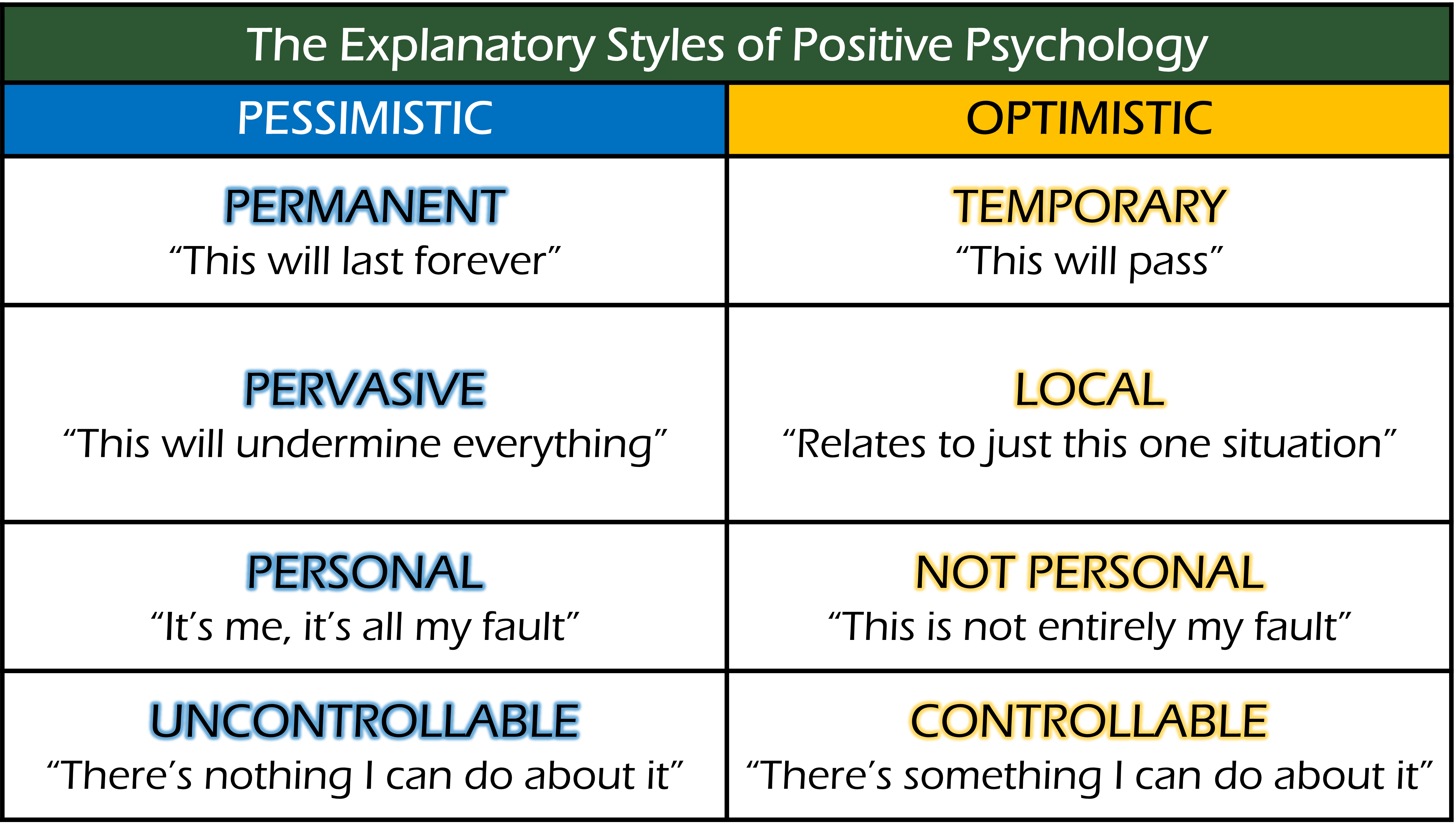
In Karen Reivich and Andrew Shatte’s book, The Resilience Factor, they describe two types of people based on Dr. Martin Seligman’s work in the Positive Psychology field and his “Explanatory Styles.” The first group are those who blame themselves for everything bad that happens to them, they are convinced that these problems will always occur and are therefore unavoidable, and that the consequences of these problems will affect every aspect of their lives. The second group faces problems without blaming it all on themselves, they believe that these problems are not permanent, and that they will not impact every aspect of their lives.
Based on Dr. Seligman’s work, the first group consists of people who think more pessimistically, they are prone to depression, anxiety, low self-esteem, and paralyzing fear and inertia in the face of setbacks and obstacles. This thought process is known as “learned helplessness” due to their habitual behavior of focusing only on negative events and outcomes that have occurred throughout their lives. The second group are more optimistic and they tend to be healthier, happier, significantly more successful at work, at school, and in sports.
It’s important to note that there is such a thing a chronic optimism, the sort that causes someone to be blinded and unaware of the risks of their thoughts and behaviors, rendering them detached from reality. For this reason, we never want to fully eliminate pessimism, there can be a healthy dose that grants us the ability to weigh pros and cons, calculate risks, and abstain from being dangerously naïve.
Learned helplessness is the thought process that results from regular exposure to negative experiences wherein the circumstances seem unavoidable and overwhelming, rendering the individual convinced that any future negative experience will also be unavoidable and overwhelming. Individuals who have fallen into the trap of learned helplessness will make no attempts to improve their own situations and will either remain idle or will rely on others to do the work of improvement for them.
When dealing with this type of barrier consider these factors:
- Adversity – what is the obstacle or setback that you are facing?
- Belief – what is your perception of the obstacle or setback?
- Consequences – what’s the result of your perception?
The most important factor here is belief because your perception of a barrier has a profound determination on whether or not you’ll be able to overcome it.
Dr. Martin Seligman suggests using the following 4-step evaluation model.
- Evidence – what are the real facts in the situation and does this evidence support or eliminate your perceptions?
- Alternatives – pessimists tend to latch onto the most dire of explanations for obstacles and setbacks, often ignoring the more positive explanations.
- Implications – pessimists have a tendency to jump from negative implications to more and more catastrophic ones, but what are the chances of these implications actually happening?
- Usefulness – just because a belief is true doesn’t mean it’s useful. Clinging to useless beliefs keeps us from working on the things that we can actually change about ourselves.
Acquiring motivation sometimes requires understanding and explanation before it can be used. Here are three recommendations for putting the above model into action:
- Internal Dialogue – talk yourself through the process step-by-step, even if that means speaking aloud. Ask yourself questions and make mental notes as you formulate answers. Thinking alone sometimes traps or prevents clarity from happening and hearing yourself talk through the process can help guide you to clear conclusions.
- Journal Writing – write out your specific circumstance using the 4-step evaluation outlined above. Visually seeing the questions and writing out the answers is an aid to our thought process and can not only guide us but also keep us on track until we reach clarity.
- Third Party – bring in someone who is external to and not bias of the situation or the consequences of any decision you make. This will allow you to see and understand the situation from a fresh perspective and could ultimately change your approach in such a drastic way that what you first thought was a detrimental outcome, might actually be a beneficial opportunity.
To help keep your thoughts and brainstorming sessions coherent, you really should document everything. Even if you’re not a writer, writing down your thoughts as you go through these models and tools can be incredibly helpful. Not writing anything down will cause your beneficial thoughts to dissipate. Think of it like rain falling on a hard surface, the sun is just going to cause the droplets to evaporate into nothing.
Use tools like task lists, action programs (which are categorized and layered task lists), or software like Sticky Notes, Evernote, or OneNote to keep track of the things you need to do. If you really want to be thorough use software like Excel or Google Sheets. The point here is to stay organized, you are far more likely to implement a transcribed action plan than one that just flutters around in your head, passing in and out of your awareness.
Similar to learned helplessness, catastrophic thinking can render you paralyzed in a cycle of fear, worry, and what ifs. This narrative of negativity is sometimes referred to as a chain of consequences, each one leading to the next. It’s this snowball effect that causes people to become paralyzed unable to make decisions or take action. Each link in this chain becomes more dire than the one that preceded it and by the end of the chain we have imagined a scenario where everything has collapsed all around us and life as we know it has become unrepairable. Nothing destroys our motivation faster than giving in to the seduction of fear, worry, and doubt.
Thankfully, this chain of thought can be broken and we can do so by following these four steps:
- Have an awareness of thought patterns
- Weigh the pros and cons of the situation
- Rank negative outcomes from one to ten by probability
- Develop an action plan for top three most likely negative scenarios
Awareness can go a long way in helping break the chain of catastrophic thinking. Being able to realize that our thinking is only taking us further and further into worry and despair is the first and most important step. The second step is to do something about it. We can do this a couple of ways, both require us to evaluate the thoughts we’re having. The first of the two methods is to weigh the pros and cons of the event or situation that we’re facing, as our minds tend to gravitate towards the negative – the worst-case scenario.
We can’t hope to build motivation if all we think about is how things might go wrong or all the negative consequences of a setback. Shifting the focus to the pros and not just the cons of every situation we face, can help us alleviate some of the stress and anxiety that obstacles and setbacks may bring. The other method is to rank the outcomes we’re imagining from one to ten, ten being the most likely to occur. Then you want to look at the top three and develop a plan of action for each of those scenarios. Having a plan can also help alleviate the stress and anxiety that we’re feeling and give us back some sense of confidence and control over the situation.
Stress and anxiety can be powerful deterrents to the pursuit of goals. For that reason I want to discuss them further and provide preventative measures and management techniques. The terms “stress” and “anxiety” are frequently used interchangeably. However, these terms do have separate definitions, based on when the response is occurring in relation to the event. In other words, each is a response occurring at different points of time, to any given experience.
- Stress – A temporary response to present circumstances that causes mental or emotional strain.
- Example: you’re currently experiencing a motor vehicle accident (in the present moment)
- Anxiety – A potentially ongoing sensation of uncertainty in response to future potential circumstances or past experiences.
- Example 1: when riding with someone who is driving erratically, you’re not afraid of the wild ride – you’re afraid of the imminent consequences (potential future).
- Example 2: you have trauma over an accident that occurred a week ago (past event)
Though stress and anxiety are normal aspects of life, anxiety that continues for two weeks or more may be a symptom of a more serious mental health condition. Frequently, those who endure traumatic experiences may develop an anxiety disorder or Post Traumatic Stress Disorder (PTSD), in addition to the stress the event initially caused. Stress is used in the term PTSD because the individual experiencing this disorder relives the event in the present moment, not just the fear of it occurring again in the future or the ongoing trauma from it occurring in the past. Those who suffer from PTSD, experience both stress and anxiety at the same time (past, present, future).
Dr. Karl Albrecht outlined in his book, Stress and the Manager, the most common causes of stress and anxiety. He determined that we experience these responses due to time constraints, anticipation (anxiety), personal situations, and through encounters with others.
He identified the following:
Time – This type of stress is frequently attributed to feeling rushed to accomplish certain tasks, such as errands, meeting deadlines for projects and assignments, and arriving to an event before it starts. Though it might make us feel hectic in the moment to be rushing around, the stress of getting something done by the deadline, can actually reinforce our commitment to it and ensure it is actually accomplished. Establishing a deadline and intentionally introducing that stress, can be very helpful in keeping us on track and maintaining our focus. Without that stress, things may never be accomplished, particularly for procrastinators.
Anticipation – This type of stress should really be called anxiety, as it focuses on a response to future events and potential situations, those that have not yet occurred or are not yet being experienced or realized.
Some common examples may include upcoming:
- Speeches / presentations / interviews
- Family gatherings / holidays / weddings
- First day on the job or first day of school
These impending events can trigger our anxiety not because of the event itself, but of our fear of not knowing how the event will unfold. For this reason, anticipatory responses such as these are self-induced or self-inflicted. Our fear of things going wrong or being a bad experience sets us up for unnecessary negativity, fear, worry, and all the other symptoms of anxiety. Individuals who are naturally pessimistic will find managing or overcoming this experience to be very difficult. However, if we are able to shift our focus away from the what-ifs our minds conjure up, and instead focus on the things we can actually control, such as our attitude, behaviors, and choices, the anxiety about these types of events can subside to a more manageable level.
Situations – Though it is a very broad category, situational stress can be clearly defined as anything we are currently experiencing. These categories would include life changes, physical illness or injuries, medication or substance use, and mental health conditions.
Some of the most common examples would include:
- Getting married / divorced / becoming pregnant
- Purchasing a new home / packing up or unpacking due to moving
- Employed at a new job / recently assigned a new supervisor
- Chronic or debilitating disease
- Motor vehicle accident
- Side-effects of prescription medication
- Excessive alcohol consumption
- Illicit substance use
- Anxiety disorders (yes, you can be stressed and anxious about your anxiety!)
- Post-Traumatic Stress Disorder
- Depression or mood disorders
Encounters – The fourth group includes experiences that those close to you are going through that are impacting you due to proximity. There are a few categories that fall into this group, such as illness or injury of loved one, loss of a loved one, conflicts with those close to you such as family, friends, and coworkers.
Some specific examples of conditions and circumstances include:
- Alzheimer’s Disease
- Cancer
- Chronic pain
- Diabetes
- Bereavement
- Financial costs of funeral services
- Disrupted emotional support network (friendships ending)
- Animosity or isolation
- Perpetually negative environment / attitudes
Knowing what stress and anxiety are and even their causes is only skimming the surface of how they impact our lives. The effects of these two mental and emotional responses can affect us in many different ways, even physically. Many studies have been conducted on the effects of stress and anxiety, especially when we are exposed to these things long-term. This long-term exposure is often referred to as chronic stress and the development of an anxiety disorder. While there is no cure for either of these, understanding their effect on us can help us understand just how important it is to utilize prevention and management strategies.
When stress and anxiety occur short-term and in mild to moderate levels, they can actually provide benefits to us. Research has shown that these responses can cause us to better react to circumstances we are currently facing or will face in the near future, and even provoke us to be proactive and be better prepared if they occur again. Experiencing stress and anxiety in the short-term can help build our resiliency to challenges and setbacks that we all experience throughout our lives. When someone is confronted by difficult events that trigger stress and anxiety, the exposure to those events strengthens their resolve to endure and triumph over any future hardship. This resilience means the individual will be less likely to feel overwhelmed or perturbed by obstacles they face. Even if success is not initially attained, a resilient person will continue to strive towards their goal because their past experience with stress and anxiety proved to them they can endure and overcome.
Clinical studies at Stanford University School of Medicine have shown that short-term exposure to mild or moderate levels of stress and anxiety can boost the immune system and speed up recovery time, due to the increase in stress hormones. A prolonged exposure has been shown to do the exact opposite – suppressing the immune system and creating greater risk for infection, as well as increasing the risk of heart disease and even cancer. The consequences of stress and anxiety highlight just how serious prolonged exposure to them can be. These consequences are vast and varied across both the mental and physical health spectrums. Listed below are the most common effects of prolonged exposure to stress and anxiety.
| Mind | Body |
| Headaches | Lack of Energy |
| Dizziness | Increased or Decreased Appetite |
| Racing Thoughts | Weight Gain or Loss |
| Feelings of Despair / Panic Attacks | Acne |
| Sadness | Muscle or Joint Pain |
| Nervousness / Worry | Increased Heart Rate |
| Anger / Irritability | Rapid Breathing |
| Confusion / Forgetfulness | Shortness of Breath |
| Insomnia | Sweating |
| Behavioral Health Conditions (Depression, Substance Use) | Trembling |
| Reduced Libido | Numbness |
| Social Avoidance | High Blood Pressure |
| Obsessiveness | Increased Risk of High Cholesterol |
| Increased Risk of Diabetes | |
| Increased Risk of Heart Attack | |
| Nausea | |
| Abdominal Pain | |
| Heartburn / Indigestion | |
| Diarrhea or Constipation | |
| Compromised Immune System |
Due to some of the debilitating symptoms of prolonged exposure to stress and anxiety, the effects can stretch beyond our bodies and minds and affect every other aspect of our lives. If your goals are profession-related then employment can often be a source of stress and anxiety. From workload to deadlines, and coworker relationships to performance expectations, it is no surprise that levels of stress and anxiety have continued to be on the rise.
This increasing mental strain is not just felt in extreme work environments such as those in the labor industry, but also in business offices where sitting in front of computer screens for extended hours on a daily basis causes physical strain that mixes with mental fatigue. There has been a major shift in focus towards workplace mental health and burnout, as more and more employers are beginning to realize the consequences of not addressing the stress and anxiety felt by their employees.
Some of the initially observable consequences of not addressing this issue include:
- Reduced ability to cope with deadlines and responsibilities
- Irritability and loss of social support
- Loss of productivity, confidence, and integrity
As with any loss in employee productivity and performance, stress and anxiety can ultimately affect the financial security and stability of an industry if left unchecked. Feeling stressed out and anxious can make us act in ways we normally wouldn’t. The effects of stress and anxiety on the connections we have with coworkers, family, and friends should not be downplayed.
Some of the most common effects that can hinder, damage, or even end our relationships include:
- Irritability, loss of patience, overreacting
- Pressure resulting in conflict escalation
- Lack of interest in socializing
While it is not possible to completely remove stress and anxiety from our lives, there are things we can put into practice that will help us prevent unnecessary stress and anxiety, or at least make it possible to manage them and the symptoms that arise. When it comes to dealing with stress and anxiety, whether we are talking about prevention or management, our first step is to identify the things that cause us to feel stressed or anxious. These causes can be quite varied, some are obvious and others may not be obvious at all. Each individual person perceives and responds to things in different ways. What might feel overwhelming to you, may not feel overwhelming to another person.
For this reason, triggers for stress and anxiety can be put into three broad categories:
- Control
- Inaction
- Pressure
Control – The sensation of a lack of control over circumstances, events, other people, and our lives in general is a very common trigger for many people. As human beings we naturally want to feel a sense of stability and safety. Any time we are facing situations where that stability or safety is interrupted and it’s beyond our ability to control, we become very unsettled, frustrated, fearful, and insecure.
Inaction – Procrastination is frequently attributed to creating unnecessary stress in our lives. For some, however, procrastination creates the stress they need to push themselves to accomplish certain goals that initially seem impossible. Without that stress, they may never achieve success. For the rest of us, our lack of desire to engage with, take on, attend, or pursue something may actually be the result of stress and anxiety. Meaning, inaction can both be a trigger for stress and anxiety, and also be a consequence of stress and anxiety.
Pressure – Any time we experience a sense of urgency or expectation, such as in pursuit of goals, we can accumulate ever-increasing levels of stress and anxiety. This pressure may be due to any number of other circumstances, particularly in regards to performance. Perhaps we have team members counting on us to accomplish a task in a timely manner, or management has expectations for high performance and a quality outcome.
In some situations, we may experience all three of these categories. We may face circumstances where we convince ourselves of, and feel as though, we have no control over the situation, but we may be under a lot of pressure to act anyway. Whether the pressure to perform is being put on us from others or we place it on ourselves, it can create such overwhelming and debilitating stress or anxiety that we become inactive and unable to do anything at all.
Research has shown that there are various methods for preventing chronic levels of stress and anxiety from accumulating, and methods for managing it in a healthy way if we do find ourselves struggling. Below are a few common practices that often get overlooked.
| 1. Eat nutritious & portioned foods | 7. Pursue enjoyable or laugh-inducing experiences |
| 2. Limit caffeine, sugar, nicotine, & alcohol consumption | 8. Celebrate accomplishments |
| 3. Get sufficient sleep | 9. Journal for self-awareness |
| 4. Exercise | 10. Take breaks from social media |
| 5. Practice mindfulness | 11. Develop physical social connections |
| 6. Set aside personal time | 12. Speak with a mental health professional (medication or therapy) |
Now that we have thoroughly covered the most significant interior barriers, we can move on to those that can be considered ulterior. Remember that ulterior barriers are difficult to detect or predict as they are neither explicitly internal nor external, but are within your ability to influence or manipulate because they are caused by individuals somewhere within your periphery. Sometimes these people’s actions are nefarious, but sometimes they are merely not cognizant of the consequences of their actions. In fact, they may at times think they are helping you. Regardless of their intentions, what often results is drama and conflict, which is a mire that you will want to bypass or overcome as much as possible either through prevention or management.
There are a vast array of practices intended to help you prevent conflict from occurring, some of these are as basic as being mindful of your words and actions, practicing empathy, listening effectively and speaking deliberately. Conflict has many causes (misinformation, misinterpretation, miscommunication) and consequently there are many things you can do to prevent it from developing, but just know that you don’t have to wait for other people to begin this process, you can proactively lean into conversations by following the V.O.C.A.B. Model created by Clair Canfield, a professional mediator.
V.O.C.A.B. is an acronym for:
Vulnerability – be open and honest about how you feel, how you’ve been impacted, and your expectations
Ownership – own up to any part you may have played in creating an unfavorable situation, know your biases
Communication – ask questions, listen to responses, learn to practice emotional intelligence
Acceptance – you cannot control other people, only your own attitude, behaviors, and choices
Boundaries – identify goals and rules such as what topics or actions you’ll avoid or engage in
One of the most useful tools for examining how to handle conflict is the Thomas-Kilmann Conflict Mode Instrument, or TKI Model for short. This model was created by Kenneth Thomas, Ph.D., and Ralph Kilmann, Ph.D., for helping people select from a number of identified styles (or what they referred to as modes) for handling conflict.
Within the model they identified five separate styles:
- Avoiding – unassertive and uncooperative
- Accommodating – unassertive and cooperative
- Competing – assertive and uncooperative
- Compromising – somewhat assertive and cooperative
- Collaborating – very assertive and cooperative
These can be better understood by examining the visual representation they created as part of the model:
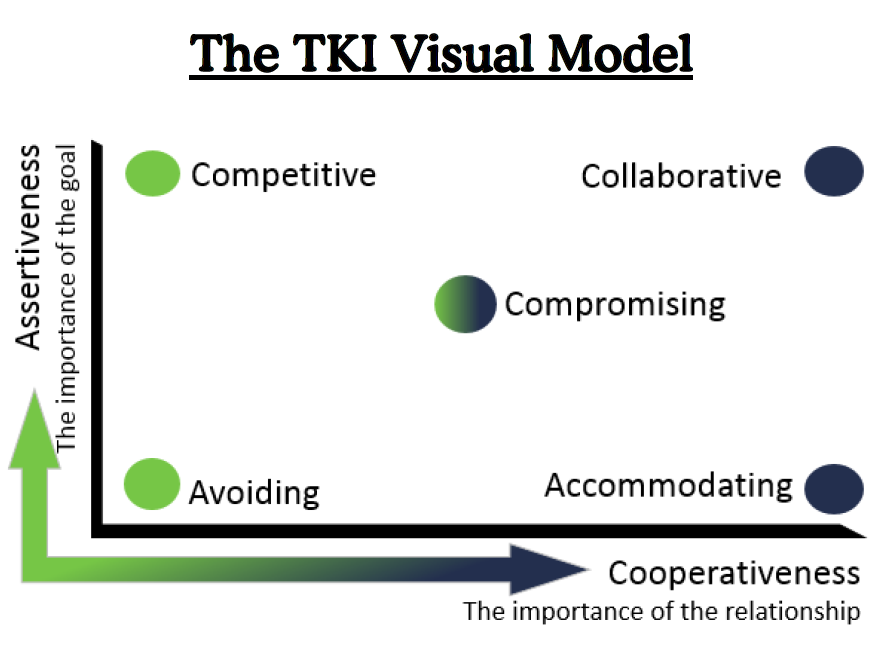
Competing – an individual pursues his own concerns at the other person’s expense. This is a power-oriented mode in which you use whatever power seems appropriate to win your own position—your ability to argue, your rank, or economic sanctions. Competing means “standing up for your rights,” defending a position which you believe is correct, or simply trying to win.
Accommodating – the complete opposite of competing. When accommodating, the individual neglects his own concerns to satisfy the concerns of the other person; there is an element of self-sacrifice in this mode. Accommodating might take the form of selfless generosity or charity, obeying another person’s order when you would prefer not to, or yielding to another’s point of view.
Avoiding – the person neither pursues his own concerns nor those of the other individual. Thus he does not deal with the conflict. Avoiding might take the form of diplomatically sidestepping an issue, postponing an issue until a better time, or simply withdrawing from a threatening situation.
Collaborating – the complete opposite of avoiding. Collaborating involves an attempt to work with others to find some solution that fully satisfies their concerns. It means digging into an issue to pinpoint the underlying needs and wants of the two individuals. Collaborating between two persons might take the form of exploring a disagreement to learn from each other’s insights or trying to find a creative solution to an interpersonal problem.
Compromising – the objective is to find some expedient, mutually acceptable solution that partially satisfies both parties. It falls intermediate between competing and accommodating. Compromising gives up more than competing but less than accommodating. Likewise, it addresses an issue more directly than avoiding, but does not explore it in as much depth as collaborating. In some situations, compromising might mean splitting the difference between the two positions, exchanging concessions, or seeking a quick middle-ground solution.
Part Four: In Conclusion
There’s not a lot more to address in regards to purpose, meaning, and fulfillment. It may seem like I dedicated most of this article to the aspects of purpose, but remember that purpose delivers us to our meaning and provides a pathway to eventual fulfillment. So, understanding how to establish an achievable purpose and how to handle obstacles and setbacks during the pursuit of that goal is critical to your success with the other two.
This model has been so incredibly important to me, I’ve been developing it and preaching it for years. It has helped guide me through some of my darkest hours, when I have felt immensely frustrated and lost in life. I know that many young people especially experience these sensations, and sometimes these feelings lead them down a path that is not so healthy, nor fulfilling.
When we ask ourselves that massive question, “What’s the meaning of life?” we can become incredibly overwhelmed and perhaps even have an existential crisis, or at the least become nihilistic. I think we should let go of that question for our own individual lives, it certainly has never served me any good. Particularly when I have come to the realization that life has no greater meaning than to merely exist, that life’s purpose is life itself: to be born, to reproduce, and to die.
I think for us as individuals, we must choose our own destiny, to choose our own path through life and not rely on someone or something else to choose for us. Each of us has a small and smoldering ember inside of us, pleading to be sparked into flame. That little glowing ember is your meaning, yearning to be known and pursued. It calls to you, lures you in the direction of your dreams because it wants to be realized, it wants you to know it – to know yourself. There can be distractions and mistaken goals that lead you astray and into misfortune and dismay, so do be careful with what beckons you. The loudest call is not always the true meaning.
It can be terrifying to answer any call, but the only way fulfillment can ever happen is if you gather the courage to wander in the direction of your dreams. After all, dreams are just really big goals. Breathe life into that little ember, feed it the kindling it needs to grow. Once you do and begin your pursuit of purpose through strife and success, you will begin to reveal your meaning in life and ultimately come to know yourself. There is perhaps nothing more fulfilling at the end of a journey than to say that you have discovered yourself.
World Suicide Prevention Day
Today is World Suicide Prevention Day!
Some of us have had suicidal thoughts in the past.
Some of us are currently having suicidal thoughts.
Some of us have put those thoughts into actions and have had abandoned attempts.
Some of us have fully attempted suicide and survived.
Some of us have lost loved ones to suicide.
Some of us have experienced all of these things.
Today is personal for us. Personal for me and for some of you, my family, friends, former colleagues, and strangers who fit into one or more of these categories.
Today, we remember our struggle. Today, we confront our struggle. And for some, we remember someone who’s been lost to the struggle.
We shine a light on a topic that too many people run away from, who wish to cast it into the darkness to be forgotten and unspoken. But these people do not understand that in the darkness it festers and spreads, for it thrives in the darkness.
Today we stand together in defiance of stigma. That wretched societal abomination that surrounds us like walls, holding us captive and unreachable. Keeping us alone in the darkness at times in our lives when the last thing we should ever feel is alone.
Not only is stigma a visual impairment, hiding us away from the world, but so too is it a silencer. Hushing our voices in fear of shame and ridicule. And so we not only stand today, but we shout. We shout loud and clear into the face of stigma, reminding all who are near that we exist and that while we struggle – we are more than the struggle. We are human.
Today I have tears in my eyes not just out of sadness for the people we have lost to suicide, but also out of joy at the people we have saved from suicide.
Nineteen years ago I did not die, instead I saw hope, breaching across the horizon in the warmth of the setting sun, as if it were a hug from a friend saying to me “Goodnight, I will see you tomorrow.”
Reminding me that after the close of the day there would be a new dawn and every dawn is a new day and every day is a new beginning. Today I am still alive because of hope, hope that change will come, hope that tomorrow will be better. Hope that was born from love. Love of myself and love shared with other people.
16-year-old me was clueless to what he would one day be able to do because of that small amount of hope he received. He was being tossed about and tumbled by the waves of emotion he was experiencing, like waves ebbing and flowing on an ocean on a moonless midnight. Too blinded and silenced by stigma to consider what the future might hold.
So, I ask you, whomever you may be and whatever your story, that you stand with me and defy stigma today and always. Shine the light of hope into the darkness and pierce the veil that has been cast upon us all. Unseal your lips and be brave enough to start a conversation that matters. Lives depend upon it. One person cannot save the world, but one person can save a life.
Give someone hope.
If you or someone you know is experiencing a mental health or substance use crisis, please access my immediate assistance resource page. A comprehensive listing of online and phone resources and services is also available.
We Are Not the Burden, We Carry the Burden

I would like to share some personal things about myself that I have been experiencing as of late, just in case others can relate. First though, I want to provide some context for why I decided to share my recent experiences.
In June, I read a memorial tribute to a young Marine who died by suicide back in 2011. After reading it I wanted to learn more about who he was as a person, so I Googled his name and found his Facebook and YouTube accounts.
Through them I learned that he was a father and a lead vocalist in an alternative rock band who played local gigs where he was stationed at in California, but I also learned that he was struggling with family drama and his own mental health and substance use issues.
I found out that he was trying to get help for his mental health issues, but was being belittled and ostracized by people he was stationed with for seeking help. Basically being told by his superiors and peers that he was weak.
The pressures of all these experiences led him to make a choice that couldn’t be undone, impacting the lives of those closest to him, leaving them behind to pick up the pieces, and leaving behind his very young daughter who would only remember what her father’s voice sounded like because of old YouTube videos of him singing.
This was a prime example of stigma perpetuating the silence of suffering, and if you know me, then you know that few other things make me as angry as stigma and the dismissal of other people’s struggles and suffering.
So, I decided to share my own issues in the hopes that it would reassure others that they are not alone. For people struggling with a mental health condition or with a substance use disorder, it can often feel very isolating and those of us with these struggles can often convince ourselves that we are the only one in the trench. This is made worse when we are belittled or ostracized and convinced into believing that we are weak and unworthy.
In the lingering midst of this pandemic many people are suffering and struggling. The first nine months for me went relatively well, then I hit a bump in the road, then shit got real ugly real quick and it was a fucking climb to get back out of the pit I had fallen into.
April and May of 2021 finally saw me climb out of that pit. I also got myself into a more beneficial workout routine and physically I am in better shape than I’ve been in for almost the last 4 or 5 years. I doubled my workout time and my sets, and made it a daily priority.
There is not a moment where I regret quitting my job in February. Don’t get me wrong, I miss the income but I was immensely unhappy there and no amount of money was worth staying. My body and mind were suffering the consequences. I was eating sugary foods, drinking caffeinated drinks every single day just to feel a false sense of enthusiasm in order to make it through the day.
I have gone from 152 lbs in February down to 132 lbs as of August. Most of the weight I lost was belly fat that I had put on after my mom died. My workout routine had become a joke, and as stated my diet was not healthy. I had pretty much stopped cooking and was eating whatever was fast or easy.
So, that change is the positive bit but life is not always rainbows and butterflies, even though social media can make it feel that way. For instance, back in early April I posted a long article about my many up-and-down mental health struggles that played a role in me quitting my job. Even right now, I am still experiencing those ups and downs.
I’m always hesitant to log into my social media accounts because most people only ever post about their successes and joys. Few people I’m friends with will ever share anything not rosey and pleasant. That’s not to say people are being fake, I think there’s just the social expectation that people should only present themselves and their lives in the most appealing light possible. To do otherwise is seen as shameful or distasteful.
For those who do share a more complete picture of what their life is really like, I do greatly appreciate it. I want to see the good, with the bad and the ugly. I want to witness the full human experience because that’s what I live.
As someone with a mental illness, I need to know that I’m not the only one who suffers, struggles, faces obstacles and setbacks, makes mistakes, and fails at some challenges. The facade of perfection is part of the stigma that forces people like me into suffering in silence. People like me become hesitant and fearful of sharing the reality that we live because of how we believe others may see it as abnormal or unwanted.
When I’m about to experience a dip in my mental health, I can feel something approaching on the proverbial horizon, I can feel this impending thing lurking out of sight. This past spring and summer I have felt panicked and anxious, this often means that I’m about to have another episode.
At times I’ve felt productive, but other times I’ve struggled to get out of bed, feeling a sense of panic and fatigue. At times it’s taken everything I have to do my workout routine. I fight to get that daily workout in because I want to feel like I have at least accomplished one thing each day.
Sometimes I don’t feel like cooking because it requires too much effort, so I go to bed without eating, but then can’t sleep. So I lay in bed until the following afternoon, beating myself up over the fact that I haven’t eaten, showered, or even so much as brushed my teeth since the morning before. Why not? Because it all felt too hard, too heavy. When I’m like this, I will also refuse to answer my phone, respond to messages or reply to emails.
Eventually I manage to drag myself out of bed despite the weight I feel. Sometimes mental illness feels like you’re carrying a heavy backpack or have chains wrapped around you and everything that should be easy is hard to do. I want to get up earlier, but I can’t, my brain won’t let me.
This is what it’s like to have a mental illness. Some days or weeks are great, others are a total shit-show. For those of us with a more severe mental illness, the things we think, feel, say, and the very decisions that we make are all influenced by our “uniquely wired” brains. A decision I made yesterday may seem wildly absurd to me today.
I constantly question myself and what I’m thinking and feeling, and I have to ask myself if it’s a product of myself or a product of my mental illness. Who’s speaking, thinking, feeling, and making my decisions? What version of me is in control today? If not self-aware, you may not even realize that you’re under the control and influence of your mental illness.
If anyone else isn’t living the ideal life right now, just know that you aren’t the only one. While most people on social media share the pleasant things happening in their lives, most of us have all kinds of shit we deal with. If not mental illness, then family or marriage issues, financial issues, physical health issues, the list goes on. Life on social media is seen through a filter, one that blocks out the bad and the ugly, but I promise you it’s there. You’re not the only one.
Like other people with a mental health condition or substance use issue who post about their experiences on social media, I sometimes receive derogatory comments or messages that essentially belittle or dismiss the symptoms of my mental illness. As someone who has lived-experience, education, training, and volunteer experience in behavioral health and recovery, I know that such invalidating comments and messages are not helpful to me or others who happen to see them.
The individuals who post these things often mean well and don’t understand that it invalidates personal experiences or emotional states by comparing me or others to people who don’t have behavioral health issues. Invalidating people’s experiences is detrimental to their mental health and their recovery.
Sometimes I come across people who will attempt to suggest that I should distract myself with tasks or errands, to just stay busy and avoid the thoughts, but distractions are like slapping a bandaid over a wound, hiding it away from yourself and others, it does not force anything to actually heal, sometimes even causing it to fester and get worse. Distracting myself and focusing on external things is part of my problem, as compartmentalizing does not resolve my issues, it only conceals them and saves them for later. I’m focusing on me because I cannot assist and receive the struggles of others while my own cup is already full and overflowing.
I absolutely agree that doing something that gives you a sense of meaning, fulfillment, and purpose is an important factor for living well and I encourage it in the recovery process, but it’s not a fix-all. It takes support from the people around you, which cannot be manifested from someone who is degrading you for how you feel or what you are experiencing. The most important thing needed is hope, the hope that things can be different, that change is possible. Telling or suggesting to someone that they are weak will never give them hope.
Consider this post a little note etched into the walls of the trench, an act of kinship towards those of you in it alongside me. I see you, I hear you, I understand you. Without judgment, without demands, without expectation. You’re already dealing with enough. People with mental health conditions and substance use disorders are some of the strongest people I have ever met.
I won’t tell you to have a good day or a good night, just have a day or a night, and I’ll talk to you in the next one.
If you or someone you know is experiencing a mental health or substance use crisis, please access my immediate assistance resource page. A comprehensive listing of online and phone resources and services is also available.


Social Media, Psychopathy, and Time Management
Posted on August 16, 2021 by Kēphen
Leave a Comment
In May 2009 I joined Twitter, two months later I deleted my account, and now twelve years after that I have rejoined the quagmire of Twitter for one single reason: it’s the only place where I can follow the vast majority of authors, scientists, philosophers, psychologists, etc., who discuss the intellectual and fascinating topics I enjoy, as very few are on Facebook or Instagram.
People like Sam Harris, David Frum, Andrew Hubberman, David Grinspoon, Yuval Noah Harari, Carolyn Porco, David Deutsch, Paul Bloom, Adam Grant, Max Tegmark, Brian Cox, Ethan Kross, Matt Haig, and the list goes on and on.
Though I’ve had an account on Facebook since 2006, I infrequently log in, thus people’s posts from a week ago show up at the top of my newsfeed when I do log in. So, for most of my friends and family, I never hit the like button on their selfies, kid or dog photos, food photos, yard sale posts, or conspiracy posts. They probably think I’m ignoring them, but it’s really that I just never see the posts.
I once considered Instagram to be easier to interact with, and all the photos and videos were more interesting and engaging, but now days I find it to be so uncompelling that I don’t know why I still log in. I just heart photos without even reading the captions anymore, most of the time just quickly scrolling while brain-dead and thumb-tapping.
I suspect my new experience with Twitter will not be anymore refreshing, but I will at least not be tweeting anything related to the humdrum that is my day-to-day life and unless a person tweets content related to science, history, physics, psychology, philosophy, economics/politics, or environmentalism, I honestly won’t be following them.
Beyond the scope of my social media ventures, these last 7 months of unemployment have been interesting. I have come to a few self-realizations, as I have been reflecting and ruminating on many things. Of particular note, I’ve come to realize that I’m far more apathetic and narcissistic than I had previously accepted myself to be.
I mean, I’ve never been particularly interested in the ongoings of other people’s monotonous daily lives and I’ve had an ever-growing ego since I was a teenager, but these past few years I have now seen that I have really pushed the limits of what is socially acceptable. To a point where I have begun to evaluate whether or not I might have some degree of psychopathy.
Not to the point where I’m worried I may engage in criminal behavior, but just to the point that I don’t find myself interested in the stereotypical things that other people desire to spend their time doing or discussing, up-to-and-including seeing or hearing them discuss the on-goings of their own personal lives.
There have been moments, particularly this year, where people have come up or messaged me and started telling me about basic human experiences occurring in their lives, like relationship issues or recent purchases or something that happened at work, and within seconds my mind was flooded with thoughts of, “Sweet baby Buddha, I hope this woman stops talking soon,” or “This is painfully boring,” or “How can I end this conversation?”
At least before, I could still pretend to be interested or fake sympathy or empathy, but recently I can’t even do that and I can tell people notice as my facial expressions and other bodily nonverbal cues give me away by expressing what I’m thinking and feeling during conversation. It feels exhausting to pretend like I care.
It’s a rather jolting conclusion to have drawn about myself, that I somehow have this growing apathy towards other people and their lives. One would think that the past 7 months that I’ve spent hidden away from the world, avoiding socialization, would do the exact opposite – grow a yearning for socialization. But no, I’m more antisocial now than I’ve ever been.
The narcissistic behavior that I’ve noticed is one that I’ve been more aware of over the years. I’ve had an issue with my ego for many years as it spawned from my adolescent insecurities. A meager way of defending myself in the midst of an underdeveloped self-confidence. It also didn’t help that I have bipolar disorder which often gives rise to irrational self-importance, feeding the ego exactly what it craves.
Being unemployed has been humbling and through the process of humility, the layers of deceit that my ego has been hiding behind have been slowly peeling away. Making the dastardly creature far easier to spot as it constantly maneuvers to renounce any suggestion that I’m not a valuable and skilled employment candidate worthy of any employer. Every rejection letter exposes the truth it refuses to believe, that I am, in fact, rather ordinary and deserve no special attention.
Sometimes my apathy and narcissism are at odds because my apathy pushes people away in fear I will have to interact with them but my ego demands their attention, creating a bizarre dance of delusion. This very writing is one of those dances – my apathy refuses to engage and communicate with other people about my thoughts, but my ego presumes to believe that people will want to read about my thoughts if I post them publicly.
I’ve attempted to make my time away from the world as productive as I can, even in the midst of a pandemic. I have been getting more reading done than I have in years, books that had been sitting around collecting dust. I’ve been writing a little too, giving this blog the attention it’s been lacking. I’ve even been sewing (no joke). But what I’ve been doing the most is consuming video-based media, truly an insane amount of streaming on Netflix and HBO Max, and even some films. I’ve also been drowning myself in YouTube videos on topics ranging from science and history to comic books and film.
I had a conversation yesterday with a friend about time spent on media like TV and video games and whether or not that time is a waste. When I was a teen and in my early-to-mid twenties, I easily played video games for 9 to 12 hours in a sitting. One could easily suggest that playing video games for that many hours was a waste of my time and brain power.
It was just such a perspective that was ultimately what pulled me away from the activity in my late twenties, I couldn’t see beyond the fact that I wasn’t accomplishing anything meaningful while sitting there, hands glued to my controller and eyes glaring at my television screen.
When I gave up that addictive behavior several years ago, I replaced it with watching vast amounts of TV, thanks to streaming services like Netflix, Hulu, and Crunchy Roll. Arguably it was worse than video games because with TV your brain is doing less work than when you’re interacting in games, and if you’re gaming with others in-person or online – you’re also socializing. TV only required me to assume a vegetative state on the couch.
One could reasonably argue I took a questionable waste of time and swapped it for an even greater waste of time. There are three arguments I could consider for continuing to watch TV: it provides an escape, it activates the analytical part of my brain, and that it mirrors elements of human behavior and society.
To elaborate a bit, the first potential positive is that it allows me to unplug from the world around me as a coping mechanism, a way to either channel or avoid the stress or anxiety caused by things happening in my life that I might not have the power or ability to change or address. The apparent negative to this would be if I’m using it to avoid responsibilities that I am capable of accomplishing.
The second positive is that it stimulates my brain in a different manner than a book because I visually and audibly learn about characters, their history, motives, the setting, anticipate future actions, and so on. While books require you to imagine the elements that are often described in the necessary detail, television and film require you to fill in the gaps created by the reduced textual elements.
In other words, books explain in detail what’s happening so that you can use your imagination to visualize how it’s happening, where as videos show you what’s happening in the absence of details so that you can analyze and decipher why it’s happening.
The third consideration is that our society molds itself from the stories we tell each other, including those stories told through the medium of television and film. Perhaps TV shows and movies help make our society better by suggesting altered human behavior, normalizing things that might otherwise seem alien or taboo. A lot of social movements rely on the power of this medium to help people see and understand various topics. Of course the negative to this is if the theme of the content is criminal in nature, certainly not something that should be normalized.
It’s hard to stop binging on streaming services because it’s addictive, just like video games. In the past year or two I’ve also taken up the habit of regularly watching the video uploads of my favorite YouTube channels. I could argue that the YouTube videos I watch are on history and science and are interesting and educational, therefore valuable, and one could argue that’s better than spending time watching fictional TV shows and movies. But in all honesty I also watch a lot of YouTube videos about comic books and movies.
I found out today that my favorite intellectual, Sam Harris, watched Game of Thrones and it surprised me because he’s so accomplished, hard working, and productive. I couldn’t believe he had spent any amount of time on a medium like television, especially since he has stated he spends very little time listening to music because he considers it less valuable than listening to audiobooks and podcasts. He went on to mention that he wasn’t the best at time management, which also shocked me.
Ultimately, if I question the time I spend doing things, I try to ask myself what I get out of it rather than what I’m losing or sacrificing because of it. The value gained should be more than the value lost. If it’s not, then I decide to agonize no longer and walk away knowing I’ve made a good decision.