
Memento Vivere
Illuminating the Facts About Behavioral Health and Rising Above the Stigma
From Samanera to Bhikkhu: The Life of a Traditional Theravada Monk
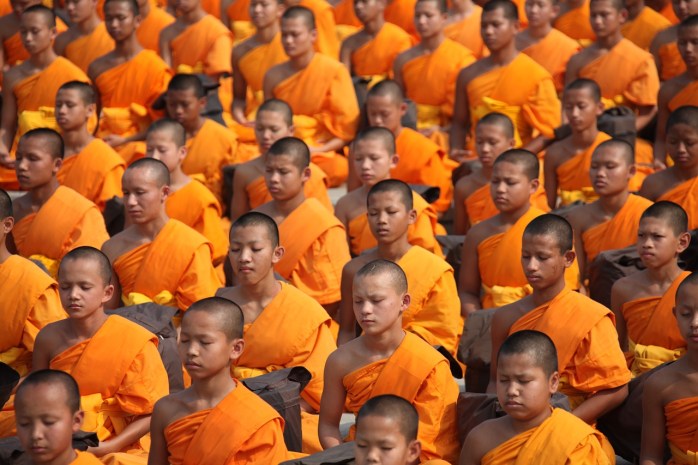
From Samanera to Bhikkhu:
The Life of a Traditional Theravada Monk
In this article we will explore the life of a traditional Buddhist monk, as seen through the eyes of a Theravada practitioner. If you don’t know anything about Buddhism, I highly recommend you check out my article, “The Middle Way and the Turning of the Wheel” which will explain where this spiritual path came from, the varying branches of Buddhism, and the core tenets of beliefs.
For someone born in the countries of Thailand, Sri Lanka, Cambodia, Myanmar, and Laos, where Theravada is the most prominent, life as a monk typically starts young. I have chosen the Theravada branch of Buddhism for this article because it has the highest ratio of monk to total population than any other branch. While laypersons can be Theravada practitioners, choosing the monastic life is seen as both a noble and respectable path. For those that choose to remain laypersons, their life is lived with far less rules, but must still follow five core precepts in order to adhere to Theravada teachings:
- Refrain from harming living beings.
- Refrain from taking that which is not freely given.
- Refrain from sexual misconduct.
- Refrain from wrong speech such as lying, idle chatter, malicious gossip, and harsh speech.
- Refrain from intoxicating drink and drugs.
In many cases, due to the poverty in these countries, parents cannot provide for all of their children and choose to give up their youngest son to a nearby monastery to become a samanera, which is a word used for a student who has not yet taken his vows and become a full-fledged monk. Once he takes his vows and is ordained, he will then be known as a bhikkhu, a term used for male Theravada monks. While girls can join female monasteries as nuns in Theravada Buddhism, they are less common and for that reason I will be focusing on only male initiates.
A Theravada monastery is known as a sangha and I will be using both terms interchangeably throughout this article. Sanghas accept initiates of almost any age provided they are in good health. Even people who are foreigners are permitted to join, and in modern times the monastic life is not one that must be chosen forever. On the contrary, many men in countries like Thailand join a monastic order when they are young and spend less than five years of their life within a sangha before returning to civilian life. Much in the same way people serve in their country’s military for a set number of years and then return to civilian life if they choose.
The process of becoming a traditional samanera as we will be exploring here, however, usually takes place when the child is old enough to perform essential personal functions for himself such as bathing, eating, using the bathroom, dressing himself, etc. When a boy becomes a samanera he is typically between five and seven years of age, so in the United States imagine kindergartners.
Though certainly a shock to the system for any boy that age, being given to a sangha is hardly an act of heartless abandonment, nor are they held there against their will. On the contrary, Theravada monasteries in these countries are held in high regard and monks are revered and respected for their piety, and it brings pride and honor to the families of the samanera if they choose to stay until they become a full bhikkhu.
A monk’s spiritual life begins years before he is formally recognized as a bhikkhu. Before he can claim such a title he must first prove himself as a samanera within the sangha. This process is called the Vinaya and is full of ritual, education, reading, chanting, doing chores, listening to dharma talks, transcribing sutras (also spelled sutta), visiting the nearby community with his alms bowl, memorizing and reciting the Vinaya Pitaka rules (also known as precepts and there are 227 of them!) eating only twice a day, sleeping, and repeating.
There are many sub-branches of Theravada and each has their own rules and teachings. In most cases, male and female samanera and bhikkhus are not allowed to intermingle or even speak to one another, hence the separate monasteries for each gender. Theravada is the most orthodox branch of Buddhism and is the most strict, having more rules than any other branch. If a samanera or bhikkhu breaks a rule or precept, it is known as pacittiya, and he must confess to other monks, or to an elder, or perform certain rituals or acts of cleansing, or if it’s bad enough he may be removed from the sangha completely. As previously stated, the rules vary from sangha to sangha, but there are certainly some rather unusual rules for some monks to follow.
For instance, male samaneras and bhikkhus in some sanghas are not allowed to come into contact with any female who happens to be inside or even those outside of the sangha, and if they accidentally brush up against one while out in the community they must return to the sangha immediately and wash themselves and their robes, and undergo fasting.
In some sanghas, males are not allowed to pass beneath public clotheslines that have female clothing hanging on them. Some sanghas require them to never eat gourds such as butternut squash or pumpkins, most cannot eat any food at weddings or funerals, nor eat left-overs, some cannot sit on ceramic urns, cannot tickle another person, cannot scare another monk with the idea of ghosts, cannot light a campfire if they are cold, cannot walk on their tip-toes, cannot lift their robe above their ankles, cannot sleep in beds that are up off the ground, they cannot cover their head or face, and the examples go on and on.
Learning the Vinaya and preparing to become a bhikkhu can go on for years, anywhere from two or more depending on the samanera’s ability to learn and practice the Vinaya Pitaka within the Pali Canon as well as other particular sections of the canon and Sutras within Buddhist scripture.
Once he is believed to be ready to become a bhikkhu, the process of ordination within each sangha may have its own specified rules, but a general example would consist of a samanera taking his vows by reciting the first ten precepts, reciting three sections of the Kammavaca (a monastic decree found within the Vinaya Pitaka), and answering fifteen questions honestly. The ten precepts include the five I’ve already mentioned above that Theravada laypersons adhere to, but also includes the following five:
- Refrain from consuming food between noon and dawn.
- Refrain from dancing, singing, listening to music, and watching entertainment.
- Refrain from wearing deodorant, cologne, and jewelry.
- Refrain from sleeping in a bed that is lifted off the ground or has a box-spring mattress.
- Refrain from accepting gold and silver (money).
The fifteen questions the samanera must answer honestly are as follows, and also included are the acceptable answers:
- Do you have leprosy? – No
- Do you have boils? – No
- Do you have eczema? – No
- Do you have tuberculosis? – No
- Do you have epilepsy? – No
- Are you a human being? – Yes
- Are you a man? – Yes
- Are you a free man? – Yes
- Are you free from debts? – Yes
- Are you free from government service? – Yes
- Do you have your parents’ permission? – Yes
- Are you at least 20 years of age? – Yes
- Do you have your bowl and robes? – Yes
- What is your name? – My name is Naga
- What is the name of your preceptor (ordaining elder)? – Venerable Tissa
Clearly these questions do not apply to everyone, as a girl is also allowed to join a sangha and become a full-fledged nun, known as a bhukkhuni. The age limit also does not always apply to new bhikkhus, as samaneras can begin their journey to the monastic life as young as five and can attain bhikkhu status within two years time (though such a feat would be astonishing). All of these rules and questions may vary depending on the sangha administering ordination. The names given in response above (Naga, Venerable Tissa) are traditional names used solely for the ceremony, and a permanent name will be bestowed upon the new bhikkhu after the completion of the ordination process by his teacher or the abbot/elder of the monastery.
At this point a samanera must surrender all possessions, including his street clothing. From this point forward he cannot acquire anything by his own request, but can only receive objects and clothing as offerings from the community or his family. By now he will have been given saffron (golden-orange) robes although some sanghas will allow the color maroon instead, they will receive a cloth belt (leather and other animal products are forbidden), a meditation mat, an alms bowl (beggar’s bowl), and depending on the sangha he belongs to he may also receive a cup, plate, two sleeping mats (one to be rolled up and used as a pillow), and a toothbrush.
His head will be shaved along with his eyebrows as a sign of devotion to the monastic life and the surrendering of the self (an act against the ego). Individualism is frowned upon in monastic life because such things can breed envy and jealousy between bhikkhu, having a standard of conformity keeps the focus on dharma practice.
Renouncing one’s possessions, titles, and hair is a sign of piety in other branches of Buddhism including Mahayana and Vajrayana, as well in some Christian monasteries where tonsure is practiced. A bhikkhu may continue to shave his head for as long as he remains a part of a sangha or he may only shave it for special ceremonies and occasions such as the anniversary of his ordination or on Buddha’s birthday. These practices depend upon the rules established at the sangha.
You may wonder why eczema would be a disqualifying factor in becoming a bhikkhu, the reason for this is that it’s a medical condition that often requires treatment. Part of becoming a Theravada monk requires you to give up all possessions which includes money and any non-essential hygiene equipment or medical supplies such as creams or ointments.
To avoid complications with these types of situations, those with pre-existing medical conditions or those who are quite elderly are dissuaded from joining. When you belong to a sangha you cannot seek medical attention without first asking permission. As you are not allowed to handle money, you cannot purchase medical supplies or medicine without permission from the elders in charge of the monastery.
All finances within a monastery are controlled by a chosen layperson. Any required medical expenses for monks must be requested and the layperson will then cover the costs incurred by the monk. This is one of the rare circumstances in which a monk is allowed to make a request, otherwise, any items received by a monk must be solely offered to them without the monk knowing about it beforehand. For example, a monk cannot ask for a pair of sandals and is typically not given them by the monastery. He can only attain them if a member of the local community offers them to him or a member of his family offers them. The same goes for books, clocks, cloth used for robes, etc.
If a monk needs to travel somewhere they must be accompanied by a layperson, lay steward or what is known as an anagarika – someone who has given up their life to be a permanent attendant to the monks within a monastery. An anagarika is required for traveling monks as they are not allowed to interact with women, make any type of monetary transaction or even touch money, and cannot order food or drink, request a ride from a taxi, or make any kind of requests from members of the community.
Once ordained the bhikkhu will continue to study the various sections of the Pali Canon and the many sutras. The daily life of a Theravada monk is quite uneventful. Much of their time is spent receiving or giving Dharma talks, attending secular classes to further their education (some even hold degrees), performing daily chores, traveling through the community from house to house in the morning seeking alms from the public, performing chants at weddings and funerals, performing chants at community events, practicing meditation, and reciting the precepts.
The average day for a traditional Theravada samanera and bhikkhu looks like this:
- Wake up before sunrise, depending on where they are this can be as early as 4:00 AM.
- For the next hour or so the monks will meditate and chant. A samanera may practice memorizing the Vinaya Pitaka, while bhikkhus may continue studying the entire Pali Cannon.
- Depending on the sangha, monks may brush their teeth before or after having morning tea. Tea plays a big role in their lives, it is one of the few things they can drink throughout the day. Part of the job of an anagarika or lay steward of the monastery is to assist elder bhikkhus in the preparation of tea and food for the sangha. It’s interesting to note that Theravada monks, in the traditional sense, are not vegan, and only some are vegetarian. In fact, some Theravada monks do eat meat if it is offered to them. Consuming honey, milk, and cheese is a necessary part of the average monk’s daily life.
- After morning tea they perform morning chores.
- By 6:00 or 7:00 AM, they travel out into the local community to collect offerings with their alms bowels. It’s important to note here that in some sanghas this is not performed every day, and in fact some retain storage rooms (sometimes off sangha grounds) of food supplies that have been donated to the monastery. Because samaneras and bhikkhus are not allowed to accept more than they need, these donations are made to the anagarika or lay steward of the sangha who then in turn prepares and offers the food to the monks at breakfast and lunch.
- At 8:00 AM they perform a ceremony and make a food offering to Buddha. Followed by their own breakfast. As with all aspects of their life, there are rules for how to eat and there are 30 of them ascribed by Buddha. These rules range from not putting your fingers in your mouth to not touching your vessel of water with the same hand that you’re eating with, and not playing with your food. Essentially these 30 rules can be allotted to the following: Do not be rude, do not be messy, do not be greedy, do not be wasteful.
- Afterwards they chant more verses of various Buddhist scripture.
- Between this point and noon, they will bathe and wash their robes. Samanera will attend Dharma talks with elder monks and practice meditation and their chants. Secular education is important in monastic life, both bhikkhu and samanera will attend classes led by elder bhikkhu and lay teachers.
- At or near 12:00 PM, they will eat lunch, their last meal of the day. Solid food after this time of day is forbidden. They are permitted to drink coffee and tea, and consume cheese, honey and non-dairy chocolate as they are not considered staple foods.
- From the afternoon until evening the monks will continue their personal studies, recite chants, memorize sections of the Pali Canon, meditate, perform chores around the sangha, take personal time, and retire for the night between 8:00 and 10:00 PM depending on the sangha.
How To Start Eating Better

How To Start Eating Better
Cooking tip: When cooking meats, eggs, vegetables, potatoes, and in some cases grains, you should saute, fry (never deep fry), grill, bake, or boil them with extra virgin olive oil as a marinade and seasoned with herbs or spices and never use butter or any other type of saturated fat or trans-unsaturated fat.
There is such a thing as a good fat and a bad fat, bad fats are saturated fats or trans fats that are in many processed foods and cooking oils and spreads, sometimes being sold as a solid in a can or jar, such as palm kernel oil, sunflower oil, corn oil, coconut oil, vegetable shortening, margarine, butter, etc.
Monounsaturated fats and polyunsaturated fats are the types of fats that your body needs to keep your bad cholesterol down and will keep your cells healthy due to the omega fat in them. Many nutrients are fat-soluble, which means they need a fat in order for your body to absorb it.
Good fats are found in oils such as olive oil, canola oil, avocado oil, flax-seed oil, and grapeseed oil. You can also bake with certain oils instead of butter or margarine, I use extra virgin olive oil as a replacement for butter in everything due to its undetectable taste and the fact that the two have recipe measurement equivalency, so one cup of butter is equal to one cup of extra virgin olive oil.
Protein Source: 30 – 40 grams of protein is your target amount per meal, as the human body can only absorb that many grams of protein in one sitting. A protein is a combination of amino acids called amino acid chains, and what’s called a complete protein is one that offers all nine essential amino acids that the body cannot produce on its own. Not all of those listed below provide a complete protein source, but all contain at least some of the following nine essential amino acids: histidine, isoleucine, leucine, lysine, methionine, phenylalanine, threonine, tryptophan, and valine.
Meats, eggs, and dairy milk provide a complete protein on their own, and so do chia seeds, however, legumes and nuts often require being matched with a whole grain such as oats to create a complete protein. Knowing this rule of matching nuts with grains will help you adequately consume all nine essential amino acids needed for muscle repair.
⦁ Eggs
⦁ Dairy Milk (or lactose-free dairy milk) or Non-Dairy Nut Sourced Milk such as cashew, almond, soy, etc. Aside from protein, milk also offers high amounts of calcium and is fortified with Vitamin D, making it the most prominent source of these two nutrients. While a certain amount of Vitamin D is found naturally in fish skin and liver, cheese, egg yolks, and even some species of mushrooms, it does not naturally exist in much else, except for one other prominent source and that’s the sun. When ultra-violet rays hit your skin, it triggers a process of synthesis, resulting in the creation of Vitamin D. Whether from the sun or milk, once in your body it must pass through your liver or kidneys for it to be used by your body. Without it, your body cannot absorb calcium properly, resulting in depleted mineralization of the bones and making them prone to breaks.
⦁ Greek Yogurt
⦁ Whole Grains and seeds such as Oats, Quinoa, Sorghum, Amaranth, and Chia Seeds – these can be found in such foods as oatmeal, cereal, whole grain bread, granola, etc, or can be purchased on their own separately.
⦁ Black walnuts, almonds, hazelnuts, pine nuts, pistachios, Brazil nuts, cashews, pumpkin seeds, watermelon seeds, peanuts, peanut butter.
⦁ Several of the above two source options can be found in nutrition bars, energy bars, and protein bars.
⦁ Legumes – such as lentils, split peas, soybeans, black beans, red kidney beans, chickpeas (also known as garbanzo beans), etc.
⦁ Protein Supplements – whey protein powder (a dairy product), such as Optimum Nutrition’s Gold Standard 100% Whey. Other protein supplements exist that derive their protein from other sources such as eggs, plants, seeds, nuts, etc., but whey is the best in my opinion, and if you’re lactose intolerant this particular brand contains the enzyme lactase which breaks down any lactose that it contains.
⦁ Meats such as chicken, turkey, fish, but stay away from red meat like beef as it is hard on your intestinal system and takes longer for your body to break down and digest, also try to avoid fatty meats like pork.
Fruits, Vegetables, and Tubers: Surprisingly, sweet peas, green beans, and gourds, are all classified scientifically as fruit and not vegetables because they develop from flower blossoms. Vegetables on the other, such as lettuce, celery, cabbage, asparagus, do not develop from a flower blossom, but instead are the plant itself or a part of the plant such as the stem or leaf. Carrots, like potatoes, grow as part of a plant’s root system so they are not technically a vegetable and are actually a tuber.
I’m putting all three of these groups together because many people don’t know or even care whether something is a vegetable, tuber, or a fruit, and honestly neither do I because they’re all carbohydrates or starches and what determines a fruit, vegetable, or tuber’s importance is its nutritional value and what vitamins and minerals it provides. Henceforth, I will refer to all of these as plants and plant products.
The reason green and dark (blue or purple) plants and plant products are pushed as “healthier” is because they allegedly contain more nutrients and anti-oxidants, but that’s not quite accurate. Color variations are actually just the result of varying pigments from phytochemicals such as carotenoids, chlorophyll, and anthocyanin. Carotenoids, give plants and plant products varying pigments such as bright red, orange, and yellow. Chlorophyll gives them their varying hues of green, and anthocyanin gives them hues of dark red, purple, and blue.
Corn, which is a vegetable that can be used as a grain when dried, contains anti-oxidants and also both lutein and zeaxanthin which are nutrients necessary for healthy eyes. Orange plant products such as butternut squash, sweet potatoes, and carrots contain beta-carotene, which is an anti-oxidant and when processed through your liver produces vitamin A (also known as retinol). Vitamin A is important for many things including to maintain healthy teeth, skeletal and soft tissue, mucus membranes, skin, and sustain healthy vision.
Another example of a food item that is not green or purple and yet still has nutritional value is the water chestnut which is white in appearance, but one serving of which contains 10% of your daily value of B-12 and potassium.
The following is just a list of some of the fruits, vegetables, and tubers I like due to taste and versatility. Add to the list all you want, there’s no such thing as a bad vegetable, tuber, or fruit (just bad tasting ones).
Also remember that herbs and spices are plants or are plant derived and therefore, deserve a place among these. Herbs such as rosemary, have long been admired for their nutritional benefits, having anti-inflammatory, anti-fungal, antiseptic, or antioxidant properties. This is why you should stop adding the mineral compound of sodium and chloride (also known as salt) to your foods and start adding herbs and spices. Even organic foods contain enough of the mineral sodium that there is no need to add salt to any food you are cooking!
⦁ Green peppers, red peppers, yellow peppers, orange peppers, romaine, broccoli, zucchini, yellow squash, butternut squash, pumpkin, cucumber, peas, green beans, watermelon, sweet potatoes, corn, red beets, water chestnuts, blackberries, raspberries, blueberries, cherries, bananas, acai berries, apples, oranges, cranberries, pineapple, kiwi, papaya, mango, and the list goes on and on.
Grains: Everyone knows that grains give you fiber and carbohydrates, but they provide a whole lot more. From iron to protein, magnesium, potassium, calcium, Vitamin B-6, Vitamin C, and Vitamin E, the following is a list of excellent grain choices that can provide some or all of these nutrients to your diet. Aside from buying these products in their own packaging, you can find them in breads, cereals, and nutrition bars.
⦁ Oats
⦁ Basmati Rice, Black Rice, Wild Rice, Jasmine Rice, Red Rice, Arborio Rice
⦁ Quinoa, Red Quinoa
⦁ Freekeh (Green Durum)
⦁ Sorghum
⦁ Amaranth
⦁ Farro Perlato
⦁ Chia Seeds
⦁ Barley
How you mix and match all of the food groups I’ve explained above for breakfast, lunch, and dinner is entirely up to you and your taste buds. Aside from eating nutritional food and cooking in the healthiest way possible, the only other thing you must consider is how much you’re eating. When it comes to the above foods, your main concern should be portions and that’s probably going to be the hardest thing to figure out.
My breakfast, which is eaten post-workout, is usually made up of about two cups of whole grain cereal with non-dairy milk and a protein shake and then once I get to work I drink a mixed combination of fruit juice, vegetable juice, and green tea. Lunch is usually about a cup of granola and a cup of Greek yogurt with a nutrition bar either for brunch or for an afternoon snack. I always eat about a cup or an appropriate serving size of each of the three food groups listed above for dinner. My body type, my lifestyle, and my body weight goals determine how much food I consume and the same should be true for you as well.
Data was collected from the following sources:
⦁ The National Institutes of Health
⦁ The U.S. National Library of Medicine’s Medline Plus
⦁ The National Center for Biotechnology Information
Human Sexuality Defined

Human Sexuality Defined
Ever since I started writing about human sexuality I realized that a lot of people really don’t even know what sexuality and orientation mean and how to use those terms.
I think that one of the biggest reasons is because of the word “sex” in sexuality. For most, this word causes them to conclude that anytime the word sexuality is used it must be in reference to the act of sexual intercourse. However, when we’re talking about human sexuality, nothing can be further from the truth.
Though assumed to be one in the same, sexuality and sexual intercourse or even just sexual activity are two separate things.
This article is intended to help people understand what human sexuality is and why it matters that we understand it.
I’ve written numerous times about how human sexuality or sexual orientation is discovered, what theories exist on why there is a scale to human sexuality or orientations, and so I will not be covering those topics in this article. I will, however, include links at the end of this article to the others where I discuss these topics in more detail.
So what exactly is human sexuality? While it certainly includes aspects of human sexual nature, the predominant meaning behind the term human sexuality should be equal to the meaning behind the term human orientation. Which is to say that human sexuality and human sexual orientation refer to the romantic desires of human beings.
When I say romance, I don’t mean candlelight dinners on a balcony overlooking the French countryside. I mean romance generally as in love, intimacy, bonding, dating, and long-term partnerships.
Human sexuality is merely intended to refer to any number of sexual orientations in which and through which human beings express love, romantic intimacy, and companionship.
The belief that sexual intercourse or any other type of sexual behavior is somehow a defining factor of human sexuality is a false belief. Sexual behavior does not define human sexuality or sexual orientation.
What gender a human being engages in sexual activity with, does not define that human being’s sexuality.
The reality is that I could engage in sexual activity with a pillow, a banana peel, a sock, or even a watermelon. Does having sex with a watermelon make me a melonsexual? No, it doesn’t. Some clinical psychologists may argue that it would make me pansexual – someone who finds sexual and emotional attraction in a broad spectrum of people, genders, and objects.
The years that I’ve been researching and writing about human sexuality have allowed me to meet individuals who, although they define themselves as heterosexual, have or are willing to engage in some form of sexual activity with other members of the same gender.
A lot of people proclaim that this means those individuals are bisexual, or that they are closeted homosexuals. The problem here is that they are basing their proclamations on one single thing: sexual activity.
As I have already stated, human sexuality is not defined by sexual activity. It is the emotional aspect of human intimacy that defines human sexuality or sexual orientation.
Therefore, if I were indeed truly in love with a particular watermelon, and indeed was sexually aroused by the fact that it was a nice looking watermelon, then yes I would absolutely be a melonsexual – emotionally and sexually attracted to melons.
However, if I merely pounded that watermelon for the sole purpose of sexual release or gratification without any emotional attachment to that watermelon or any appreciation for the appearance of the watermelon, then it is solely a sexual act, and has nothing to do with my sexual orientation, only my libido and sexual impulsiveness.
The bottom line here is that sexual acts without emotional interest, attachment, or expression, does not determine or define human sexuality or sexual orientation.
A self-proclaimed heterosexual woman who has engaged in sexual activity with another woman is still a heterosexual woman. A self-proclaimed heterosexual woman who falls in love with another woman and engages in sexual activity with said woman is not a heterosexual woman, but indeed a closeted lesbian or bisexual.
As a man who can and has fallen in love with other men, I am not and will never be straight. If I quit engaging in sexual activity with other men for the rest of my life or if I had never engaged in sexual activity with other men ever in my life, and were only sexually active with women, I would still not be straight.
This is what many people who are not lesbian, gay, bisexual, or transgender do not understand. What sexuality or orientation a human being is, is not defined by what they look like, what they say, or even what they do. Sexuality and orientation are determined by what a human being feels.
Falling in love, romantically, with someone of the same gender means that you are not straight or a heterosexual, you are definitely gay or bisexual. Engaging in sexual activity with someone of the same gender without any emotional attachment, means nothing more than that you are horny.
To learn more about human sexuality, check out my previous articles:
Alone In The Dark

An Educational Report by Kephen Merancis
Introduction
This report is intended to educate the public on the risk of suicide in those under the age of fifteen. It is my hope and my intention that through education and awareness, we can stem the rise in the number of children completing suicide.
“Be brave enough to start a conversation that matters.”
– Margaret Wheatley
Alone In The Dark:
Why Children Attempt Suicide and How to Prevent It
According to the Centers for Disease Control and Prevention, from the year 2000 to the year 2014, more than 530,000 Americans completed suicide. In the year 2014 alone, the number of Americans of all genders and all age ranges that had died by suicide was 42,773. It was the highest number in one year during the fourteen-year period since 2000. In comparison, 37,195 Americans died in motor vehicle accidents that same year.
Further, the yearly total of Americans completing suicide has continually and dramatically risen each year since 2000, whereas the number of deaths due to motor vehicle accidents has continued to drop since 2006, except for 2012 when deaths spiked to 38,251. While the elderly have the highest rates of suicide per population, followed by those of middle-age and young adults and teens respectively, children under the age of 14, and even as young as 5 also end their lives by suicide.
In 2006, there were only fifty-six known cases of children under the age of 12 who had completed suicide. Of those children, forty-five were boys, which coincides with the trend that about 79% of all suicide victims in all age groups are males, even though girls attempt suicide more often. In 2013 there were 395 cases of child suicides for the age group 5 to 14. For those 10 – 14 years in age, there were 409 suicides in 2015. Self-harm and suicide attempts among children under the age of 14 has doubled since 2006.
According to population reports from the United States Census Bureau, there were 73.6 million children aged 17 and under in the United States in 2014. According to the World Health Organization, during that same year in the U.S., one in every 100,000 boys aged 14 and under died by suicide. For boys aged 15 to 24, nearly eighteen in every 100,000 completed suicide. For men 75 and older, thirty-eight out of every 100,000 died by suicide.
From 2008 to 2015, there were 118,000 children between the ages of 5 and 17 admitted to thirty-two hospitals across the country who expressed suicidal thoughts or the desire to harm themselves.
Most children under 14 who attempt and die by suicide do so by hanging or suffocation at home, often in their bedroom. Of those, most have attempted it at least once before, often without anyone knowing about it. In fact, it’s estimated that for every child that completes suicide, a dozen others have already attempted it or have thought about attempting it.
The decision to attempt suicide in children under the age of 14 is almost always impulsive and reactionary to an external stimulus, in all cases they feel alone and helpless in what they’re dealing with.
This impulsive nature makes it very difficult to prevent child suicide because a child can appear energetic and seemingly happy in one moment, and then one negative experience later they may make the decision to end their life without fully grasping the finality of the act or realizing that circumstances can change over time.
For teens and older age groups, depression is often directly involved, so much so that two-thirds of all suicides in these age groups are connected to depression, often spanning years.
Children on the other hand, do not fit into this trend. Less than half of child suicide victims experience depression and for them it occurs on a rapid scale of days or weeks prior to completing suicide. It’s important to note that over half of all children who attempt suicide had previously been diagnosed with ADD or ADHD.
Most child suicides are preceded by a conflict with a parent, friend, classmates, and social interactions with strangers online, including cyber bullying. In recent years, social media sites and apps such as Facebook, Twitter, Instagram, and Snapchat have played a major role in the emotional states of children and pre-teens. Sometimes the prevalence of online activity can be helpful in identifying at risk youth, due to the child venting frustration, stress, anxiety, or the desire to self-harm. However, in other cases the conflict itself unfolds online where adults are not present, leading the child to be cut off from support, and later completing suicide without the parent having any prior knowledge of what was happening.
Despite their impulsive nature, there are warning signs that can be observed in a child who may attempt suicide. Mood is always a key factor to monitor, this would include anger, aggression, irritability, frequent crying or easily triggered by sadness, disinterest in previously favored activities, constant involvement in physical fights, theft, constantly withdrawing from social interactions, and refusing to go to school.
Aside from mood, children often let slip things they’ve been thinking about, especially when they get frustrated or angry. Phrases such as, “I wish I were dead,” “I hate being alive,” “I just want to die,” “I wish I could go to sleep and never wake up,” “I just want to sleep forever,” are all red flags a parent should pay attention to.
Phrases like these are tell-tale signs a child has witnessed or is experiencing something that is causing them a lot of anxiety or stress that is beyond their ability to cope with alone, and that they have begun viewing death as an escape.
A child’s impulsive desire to attempt suicide is met by a desire to escape something they cannot process or handle. Trauma, fear, neglect, abandonment, harassment, bullying, verbal or emotional conflict or threats, embarrassment, physical assault, hazing, and sexual abuse, can all precipitate a suicide attempt in children.
Another common behavior in children with a risk of suicide is self-harm or self-injury. Prior to attempting suicide, children will intentionally harm themselves or engage in risky behavior where they know they can be injured.
Like teens and young adults, children tend to blow events out of proportion and become consumed by them. What may seem like a trivial event or temporary circumstance to you, may appear to be life shattering, permanent or inescapable to a child.
Most children seldom anticipate life beyond several days into the future and it’s due to the ongoing development of their brain. They are simply not yet able to anticipate life that far into the future or imagine how the circumstances of their life can be drastically different years, months, or even just weeks into the future.
This inability to envision a distant future adds to a child’s belief that current events or circumstances are unchanging, are unable to be fixed, are unavoidable, unforgivable, or unending. Whether with parents, teachers, or mentors, it is fundamentally important that a child have an open relationship with an adult or young adult to whom they look up to and can communicate with freely and rely on for advice, encouragement, safety, emotional support and stability.
Giving a child the opportunity to talk about things without judgement and without repercussions is essential for a trusting, honest, and open relationship. The sort that could, if need be, save them from making an impulsive and life-ending decision.
After discovery or intervention, appropriate pediatric counseling should be initiated in children who have attempted suicide or are showing suicidal ideology. Never assume it’s a phase or that they are too young to be suicidal. Mental health care is as equally important in children as it is in teens and adults, giving them the skills they need to better deal with the issues they are facing and will face in their future.
Sources of data included reports and publications from the following:
- The World Health Organization
- United States Census Bureau
- The Center for Disease Control and Prevention
- The American Academy of Pediatrics
- The Academic Pediatric Association
- The American Pediatric Society/Society for Pediatric Research
- The National Center for Health Statistics
- The National Institutes of Health: National Institute of Mental Health
- The American Foundation for Suicide Prevention
- The Society for Academic Emergency Medicine
If you or someone you know is experiencing a mental health or substance use crisis, please access my immediate assistance resource page. A comprehensive listing of online and phone resources and services is also available.
Nationalism and Police Brutality: The Deafening Sound of Ignorance
“The well-being of mankind, its peace and security, are unattainable unless and until its unity is firmly established… It is not for him to pride himself who loveth his own country, but rather for him who loveth the whole world. The earth is but one country, and mankind its citizens.”
– Mirza Husayn Ali (1817 – 1892)

Nationalism and Police Brutality: The Deafening Sound of Ignorance
From false patriotism to allegations of police brutality, nationalism is deeply a part of today’s American political commentary and those with opinions on either side attempt to silence the other. In my attempts to observe and research, I’ve only come to the conclusion that these attempts to silence are actually just the deafening sound of ignorance, touted by those who are bound and blinded by their own political identity.
As is the case for the past few decades or perhaps longer, the American people divide themselves quite willingly into two sides. Those who proclaim to be patriotic and acknowledge no legitimate errs in the American way, and those who point out the ills of American policy and procedure.
When I enlisted in the Marine Corps ten years ago, I didn’t do so because I wanted the government to pay for my college education, I didn’t do it because I thought it would be a good time, nor even because I wanted to serve my country. I didn’t swear that oath because I wanted to be congratulated or because I wanted people to shake my hand and say thanks. I swore my oath in the belief that it was the best way for me to serve a purpose in life far greater than myself.
The Oath of Enlistment has had a few revisions over the centuries. On June 14, 1775, the then Continental Congress approved the oath to read:
“I _____ have, this day, voluntarily enlisted myself, as a soldier, in the American continental army, for one year, unless sooner discharged: And I do bind myself to conform, in all instances, to such rules and regulations, as are, or shall be, established for the government of the said Army.”
On September 20, 1776, it was revised again to:
“I _____ swear (or affirm as the case may be) to be trued to the United States of America, and to serve them honestly and faithfully against all their enemies opposers whatsoever; and to observe and obey the orders of the Continental Congress, and the orders of the Generals and officers set over me by them.”
On September 29, 1789, the oath was changed again, this time under the Constitution and was split into two separate statements to read:
“I, A.B., do solemnly swear or affirm (as the case may be) that I will support the constitution of the United States.”
“I, A.B., do solemnly swear or affirm (as the case may be) to bear true allegiance to the United States of America, and to serve them honestly and faithfully, against all their enemies or opposers whatsoever, and to observe and obey the orders of the President of the United States of America, and the orders of the officers appointed over me.”
In 1960 an amendment changed the oath for the last time, to include a statement on God. This infiltration of religiosity, was common between 1940 and 1960 as a part of anti-communist propaganda. Such statements found their way into the Pledge of Allegiance, as well as on all American currency. Rendered effective as of 1962, the oath now reads:
“I, (______________), do solemnly swear (or affirm) that I will support and defend the Constitution of the United States against all enemies, foreign and domestic; that I will bear true faith and allegiance to the same; and that I will obey the orders of the President of the United States and the orders of the officers appointed over me, according to regulations and the Uniform Code of Military Justice. So help me God.”
The reality is our nation’s sense of patriotism has long been poisoned by political statements and propaganda, culminating in vitriol nationalism. Identity politics now frames our political landscape and is our nation’s newest form patriotic subjugation.
Nationalism, the zealous pride in one’s nation of origins and a belief in its superiority, is now a tool used by political entities to attain agendas. The American people in this way are puppets, being pulled in one direction or another based on the desires of the players on the political field, and we unfortunately and mistakenly believe this to be representative democracy.
Though touted as the pinnacle of a patriot, nationalism is far from the purity it is often rendered and is not the same as patriotism. Instead it is often used as a weapon for political or even ethnic statements that divide rather than unite.
We now live in globalized interconnected communities. The events that take place halfway around the world, now quickly impact every other nation invested in it, whether that be economically or politically. Natural resources through sales, traded goods through import and export, cooperation in international infrastructure, international travel, political alliances and peace-keeping, all of these things affect every global community involved.
Nationalism has not only impacted American politics and the way in which the United States interacts with the international community, but it has also found its way into the personal lives of American citizens and alters the way in which they see their neighbors and how they approach controversial topics.
One of those topics is police brutality. With both civilians being shot by police and police being killed by civilians, these incidents find their way onto the front page of any city’s newspaper and the headline news on any network. While not true for all Americans, many U.S. citizens are divided into two camps; one side arguing that the militarization of police forces since September 11, 2001 and racial discrimination have both led to a rise in the use of extreme force and thus police brutality, and the other side arguing that a rise in civilian hostility, disrespect, and resistance to cooperation with police has led to an increase in violent conflicts between police officers and civilians.
So what’s true here? Which side is right about what’s happening? From what I can tell, both are right and both are wrong. This topic is far more complicated than most American’s are willing to think about. British philosopher Bertrand Russell put it beautifully, “Most people would rather die than think, in fact, they do so.”
Emotional responses are the key factor in how Americans chose to view a topic, which is the absolute worst way to draw any conclusion on any topic. Emotions are intended for personal relationships between people, and it is there that those emotions should remain. Bringing emotions into topics such as politics and social order, is both disingenuous and unintelligent. How you feel about a topic does not determine truth or rationality, it only causes people to extrapolate false beliefs.
I’m going to give you an example of how an emotional response dilutes a person’s ability to discern between truth and bias opinion. According to the National Law Enforcement Memorial Fund, and the Law Enforcement Officers Killed and Assaulted Report by the Federal Bureau of Investigation, and the Washington Post, for every one police officer in the U.S. killed in a violent altercation with a civilian, 19 civilians have been shot by police. So again that’s a ratio of one police officer killed for every 19 civilians shot.
Looking solely at that ratio, one quickly thinks that the statistics show that police kill more civilians than civilians kill officers. So if you’re inclined to believe that police brutality is an endemic problem in America, then your bias opinion is supported by this data.
However, like all important issues, nothing can be explained so easily. The first question you should have asked yourself when reading the data I provided above is “What about population?” Yes, population matters, because there are far more civilians in the United States than there are police officers. Let’s look at those numbers.
According to the U.S. government, there are some 325 million Americans and according to the Uniform Crime Reporting Program and the Annual Survey of Public Employment and Payroll, there were about 983,671 employees at police stations across the country in 2012. It’s important to note that these reports looked at employees, and not strictly at those in uniform. According to the FBI’s Law Enforcement Officers Killed and Assaulted Report, there were 724,690 uniformed police officers serving across the country in 2013, the last time any source had access to this data.
The number of police officers in the United States has been steadily increasing. In 1975 there were 411,000, in 1985 there were 470,678, in 1995 there were 586,756, and in 2005 there were 683,965. That’s an average increase of 78,423 every ten years from 1975 to 2013.
Let’s look at the incidents involving civilian and police violence. According to the National Law Enforcement Memorial Fund, an average of 50 police officers each year for the last four years (2013 – 2016) have been killed in violent altercations with civilians. These deaths include shootings, knife attacks, beatings, and strangulations.
The Washington Post and The Guardian are currently the only known complete sources of data on how many people have been killed by the police. The Federal Bureau of Investigation has stated that they do not keep track of this data other than what is voluntarily reported by police stations, which I find to be absurd and astounding. Never the less, the politically left-leaning Washington Post keeps track of civilians shot by police based on police reports, public sources, and news reports. On average in 2015 and 2016, there were 979 civilians shot by police each year.
As of September 6th, there have been 684 so far this year (2017), which is on track with the previous two year records. The Washington Post also breaks down their data to include factors such as age, race, and gender of the civilian, if the civilian was known to have a mental illness, if the civilian had a weapon, if there was police body cam footage, etc. You can access this data for 2017 and find links for the data from 2015 and 2016 at this link.
Now that we have our numbers lets take population into account. If there were an average of 50 police officers killed by civilians each year from 2013 – 2016 and the average number of police officers serving from 2010 – 2013 is 719,853 then that equates to a percentage of 0.007% of police officers had been killed by civilians.
If the federal data is correct and there are roughly some 325 million Americans, and the Washington Post’s data of 979 civilians dying each year from being shot by police is accurate, then that equates to a percentage of 0.0003% of American civilians being shot by police.
According to these calculations you are more likely to die at the hands of a civilian if you are a police officer, than you are to die at the hands of a police officer if you are a civilian.
Unfortunately this isn’t everything you need to know. The issue is yet even more complicated. While half of all civilians who die at the hands of police are racially white and the other half a collective of racial minorities, when you take the demographics of population into account, you learn that African Americans are being shot and killed 2.5 times more frequently than white Americans. Even though African Americans make up only 13% of the total U.S. population, they make up 26% of the people killed by police.
Things get even more complicated when you take into consideration that nearly 50% of all convicted murderers in the U.S. are African Americans, but are also much more likely to be the victims of violent crime than any other race, and also the victims of assailants of the same race (black on black violence). African Americans, along with Hispanics, are more likely to be harassed and experience the use of force by police than white Americans. This type of force includes firearms pointed at them, being handcuffed without arrest, being pepper-sprayed, hit with a baton, and tasered.
You can read a report on racial differences in the use of police force in this publication by Roland Fryer Jr., a professor of Economics at Harvard University.
As you can see from the data provided that coming to any conclusion is difficult to do and that you cannot look at this issue or any other issue from just one side. Nationalism is a distortion of the truth, a bias filter through which those with a political agenda see the nation and our social issues, as well as encourage others to see them. There must come a day when the majority of Americans stop seeking confirmation bias and stop living in silos of political identity. We all must become harbingers of evidential truth, see the nation and world as they truly are, set aside false beliefs, shake off delusions and biased opinions.
“Be brave enough to start a conversation that matters.” – Margaret Wheatley
The Middle Way and the Turning of the Wheel

The Middle Way and the Turning of the Wheel:
A Brief Examination of Buddhism
Buddhism has its origins in the late 6th century BCE with the teachings of the Buddha in Northern India and Nepal. The Buddha, which is a title and not a name, was born Siddhartha Gautama sometime around 567 BCE to a wealthy royal family in the Kingdom of Shakya (Sock-Ya). At the age of 29, Prince Siddhartha abandoned his wife Yasodhara, his son Rahula, and his royal inheritance after realizing that all the worldly materials he was surrounded by and was set to inherit, would never save him from the impermanence of human life. This disturbing realization came to him when he left the palace grounds for the first time in his life and laid witness to disease, old age, and death.
Siddhartha wandered for some time after abandoning his home and family, seeking wisdom from spiritual leaders of the various Vedic traditions which were then common in this part of Southern Asia. These Vedic traditions would one day spawn Hinduism, which has an intertwined history with Buddhism as it influenced Siddhartha’s own beliefs along his journey down the path of the Middle Way.
Siddhartha fled the comforts of the Shakya Kingdom and immersed himself with the lands and people beyond to better understand the human condition. In the years that followed his self-imposed exile, he finally reached enlightenment (nirvana) at the age of 35 on a full-moon May night, beneath a sacred fig tree known as the Bodhi Tree, in the Indian town of Bodh Gaya (Böd-Guy-Ya). After this, he frequently gave dharma talks in and around the famous deer park in Sarnath. It was at this point he endearingly became known as Shakyamuni Buddha, or the Buddha for short.
After giving a succession of three prominent dharma talks, Siddhartha who by then referred to himself as Tathagata, set into motion the origins of the Tripitaka or Pali Canon and eventually the formation of modern Buddhism. Initially only one branch of Buddhism existed, but in time after the Buddha’s death in 483 BCE, disagreements would arise in his followers and cause Buddhism to break into three main branches of traditions, with many lineages and schools of thought within each.
The term branch in Buddhism is similar to the term denomination in Christianity. It merely denotes a separation in the practices and beliefs within Buddhism. Though all branches descend from the teachings of the Buddha, the lineages of traditions in our world today are quite different from one another.
The oldest and the smallest of the main branches of Buddhism, according to the population of adherents, is known as Theravada (pronounced Taar-Ravada), which means School of the Elders, and is mostly found in Thailand, Sri Lanka, and other parts of Southeast Asia. Theravada is mostly practiced through the monastic lifestyle as it is very orthodox in its tenets and beliefs.
The largest and second oldest branch of Buddhism is known as Mahayana (pronounced My-E-Yawna), a word meaning the Great Vehicle, which refers to the particular method taught to adherents in their path to enlightenment. Though the highest populations of practitioners is in Asia, many people around the world practice this version of Buddhism through one of eight schools or lineages.
The second largest and most esoteric is known as Vajrayana (Vatch-Ree-Yawna) and includes the well-known Tibetan Buddhism and one of its most prominent leaders the 14th Dalai Lama. Vajrayana emerged from Mahayana sometime between the 3rd and 13th centuries, carrying along with it a worship of deities that are heavily influenced by ancient Vedic beliefs.
Things get complicated within each of these branches of Buddhism, as they all have many sub-branches and schools of tradition within them and lineages of teachers. Sometimes these lineages are passed down from father to son, sometimes they are passed on to revered students, or the helm may be passed on to believed reincarnations of previous teachers through a process known as divination, where they are enthroned with a title. This divination process is how Tibetan Buddhist leader Tenzin Gyatso earned the title of the 14th Dalai Lama.
Because both Vajrayana and Tibetan Buddhism emerged from Mahayana, both traditions are also influenced by Yogic and Tantra practices and Vedic traditions from India. Tibetan Buddhism is one of the most well-known traditions of Buddhism in the West, in all there are seven different schools within this tradition alone.
Rinpoche, pronounced Rin-Po-Shay, is a title meaning honorable. Along with other titles within Buddhism, it’s given to those who have reached a high level of understanding and respect within various lineages of the branches of Buddhism. Titles can be given by birth, experience, status as a reincarnated teacher, or be granted by those of a higher ranking out of admiration or respect. Other titles within Buddhism include Lama, Tulku, Karmapa, Dorje, Roshi, Thich, just to name a few.
The name Buddha is a title as well, but only one Buddha can be known in each eon. There have been six Buddhas in the past that have been named, the current Buddha Siddhartha Gautama, and there will be another in the future, who’s name will be Maitreya. Anyone else can also attain nirvana or enlightenment during an eon, but these individuals are referred to as Arhats and not as Buddhas.
Zen Buddhism is another sub-branch of Mahayana. One of the most prominent leaders of this branch of Buddhism is Thich Nhat Hanh, a Vietnamese Zen monk lovingly known to his followers as Thay. Most Zen Buddhists do not worship deities through mantras or yoga, but instead place a lot of attention on being mindful of every moment of life. Through Koans, which are phrases or questions from Zen Masters, students meditate on the lessons or meanings intended, essentially forcing them to think abstractly about the world and about life.
Thich Nhat Hanh is a pioneer in what is known as “Engaged Buddhism,” a practice that declares Buddhism as not merely something you believe in, but something that you do, which is a return to the roots of Buddhist practices developed by the Buddha. The term Bodhisattva was coined in Mahayana Buddhism to indicate someone who has forgone their own enlightenment to help others break free of their dissatisfaction and end the cycle of birthing and dying.
Nichiren, pronounced Nee-Chee-Ren, Buddhism originated during the 13th century in Japan by a monk of the same name and is another tradition of Mahayana Buddhism. The practitioners of this tradition place a lot of value on chanting the mantra Nam-Myoho-Renge-Kyo, a mantra derived from the Lotus Sutra.
Mantras are essentially just like prayers spoken by followers of the Abrahamic religions, but depending on which tradition of Buddhism you adhere to, the value, purpose or intention behind these mantras can change. By this I mean that some mantras are chanted with the equal intention of Christian or Muslim prayer, by which the devotee is hoping that a Buddhist deity will hear his or her pleas or praise. In other traditions no such belief exists and mantras are solely meant to raise the mindfulness of the practitioner, to reach higher levels of clarity and peace. Mantras can be chanted aloud, repeated below the breath as a part of mindful breathing, and can be counted by using a Mala.
Malas are the Buddhist version of prayer beads, similar to the rosary in Catholicism, the lestovka in Old Orthodox Christianity, japa beads in Hindu and Yogic traditions, and the misbaḥah used in some sects of Islam. The mala can come in various sizes, styles, and the number of beads can very, though the most common is 108 beads. The number 8 represents the Ashtamangala, a collection of gifts received by Siddhartha Gautama after he reached enlightenment (nirvana), but are also considered auspicious symbols in other religions in and around India. These symbols in no specific order include the conch, a pair of goldfish (sometimes Koi), the eternal knot, the sacred lotus, a vase, a parasol, victory banner, and the Dharma wheel. Each item holds a specific meaning that varies within each Indian religion.
Like all other world religions, Buddhism has several sacred texts, known within the traditions as the Tripitaka, also known as the Pali Canon, and the Sutras. The Pali Canon are the teachings of the first Buddha, Siddhartha Gautama and his disciples and scholars, in a collection of ancient writings recorded in their original Indian language of Pali. They were recorded sometime in the year 29 BC by the Fourth Buddhist Council in Sri Lanka, 454 years after the death of Siddhartha. Prior to being recorded in text, these teachings were spread by spoken memory, recited aloud by those who had managed to memorize the teachings.
The Sutras on the other hand came later, covering a span of two hundred to four hundred years later and containing more than two thousand texts. The most well known sutras are the Lotus Sutra, the Heart Sutra, and the Diamond Sutra. Reading from the Pali Canon or the Sutras, you quickly learn that the tone of these documents are much different than the Holy Bible or the Qur’an. The reason for this is the man or his disciples from whom the texts were transcribed from. Siddhartha Gautama never believed himself a prophet for a creator, nor a demi-god, he was merely a man who found his way to nirvana, an inner peace found through complete separation from the self.
The teachings of Buddhism are complex and vast. Different traditions practice different variations and interpretations of these teachings. For any young monk joining a monastery within any of the three main branches of Buddhism, awaits a life long journey of reading, learning, and practicing, which includes memorizing the particular branch’s interpretation of the Buddha’s teachings, along with any other teachings of venerated individuals who followed the life of the Buddha.
Though over-simplified, one could hold the Three Jewels, the Three Universal Truths, the Four Noble Truths, and the Eight-Fold Path as the core teachings of Buddhism. The Three Jewels of Buddhism, also known as the Triratna (Tree-Rut-Na), are something of a declaration of intent or faith. In fact, many Buddhists use the Three Jewels as part of their initiation process, as do monks during ordination, making some statement along the variance of “I take refuge in the Buddha, I take refuge in the Dharma, I take refuge in the Sangha.”
The Triratna can be symbolized in different ways, sometimes as literal jewels of three colors: yellow (Buddha), blue (Dharma), and red (Sangha). Other times it is symbolized in a similar design as the Yin-Yang, except with three shapes swirling rather than just two and are often colored yellow, blue, and red.
The Three Universal Truths (Anitya, Duhkha, Anatman) represent, if not accepted, the first barrier that keeps Buddhists from escaping samsara. All Buddhists must come to accept these truths to break the cycle. The Three Universal Truths are:
- Anitya (Impermanence) – nothing lasts forever or is unchanging
- Duhkha (Suffering) – nothing is perfect, to desire perfection is to endure dissatisfaction
- Anatman (Non-Self) – Nothing is separate, not even the self (there is no self or soul)
The Four Noble Truths which came from Siddhartha himself, teach the following:
- Duhkha – In the cycle of life, known as samsara, there is suffering and a student of Buddhism must acknowledge this suffering in himself and all others.
- Samudaya – A student must come to understand this suffering, to discern its origins; where it came from, why it arose, etc. In Buddhism, duhkha is not just physical, it can also be mental or emotional. Dissatisfaction is a type of duhkha and can arise from the Skandhas or Five Aggregates as outlined in Buddhism:
- Rupa (form – sentient, solidity, cohesion, heat, motion)
- Vedana (sensation)
- Samjna (perception)
- Sankhara (volition/will)
- Vijnana (mind/thought)
- Nirodha – Because the suffering has a source, it must also have an ending. Therefore, a student must discover what is the cessation of suffering.
- Magga – Once discovered, a student must practice and attain the end of suffering within himself, and go out into the world and assist others in the ending of their suffering.
While these four truths may seem really simple and easy to understand, there is a whole lot more to each of these lessons than I could put into an article. The question of what is defined by suffering is debated within the branches of Buddhism and within the sub-branches of each of them. How to go about ending whatever definition of suffering you ascertain is another topic of disagreement. And whether or not a student should concern themselves with ending the suffering of others and not focusing solely on his own liberation from the self (nirvana/enlightenment) is a major divide between Theravada and Mahayana Buddhism.
It was once believed that only the most devout adherents of the Buddha’s teachings, those who followed the most orthodox tenets and practices, could ever reach nirvana, and that this path was intended for only those who led a strict monastic lifestyle. Through this lifestyle, practitioners were not only required to follow the Five Core Precepts found in the Vinaya Pitaka of the Tripitaka that all Buddhists adhere to, but were required to live in accordance with the full 227 precepts.
This is what caused the break in Theravada Buddhism, as some practitioners disagreed with this and concluded that the common people could also reach enlightenment. From this disagreement arose the Mahayana tradition, the Great Vehicle by which many could follow the path to enlightenment.
The Eight-Fold Path is a breakdown of the Four Noble Truths, essentially a guide from the first Buddha on how to live a life that will lead a student to enlightenment. It is a collection of practices that reinforce moral and ethical behavior, the practice of meditation, and the understanding required to release an attachment to the self, which is often the source of suffering and the impediment to nirvana. The Eight-Fold Path includes the following insights:
- Right View: Attain moral perception, ethical behavior, and realize the consequences of the accumulation of karma.
- Right Intention: Enact the renunciation of the ego, of negative or harmful action, addictions, habits, desires, and thoughts.
- Right Speech: Speak and embrace the truth, uphold your integrity.
- Right Action: Embrace nonviolence, uphold dignity, compassion, and loving kindness.
- Right Livelihood: Practice non-attachment, be minimalist, turn from greed and living in excess, serve others, and give to those in need.
- Right Effort: Be honorable in your thoughts and your actions with others.
- Right Mindfulness: Become mindful of the interconnections of everything.
- Right Concentration: Practice meditation, transcend the self, reach enlightenment.
Siddhartha Gautama gave many teachings during his lifetime to those who would listen, but there are three that stand out in Buddhist literature. These lectures consisted of the Four Noble Truths, the detachment from the ego and the embrace of the practice of compassion, and the realization that each human has their own Buddha nature.
He gave them after he reached nirvana under a Bodhi tree, and each is called the turnings of the Dharma Wheel. The Dharma Wheel, also known as the Dharmachakra, represents time, life, and the cycle of samsara (cycle of life and death). With every lecture he gave, Siddhartha is said to have turned the wheel, setting into motion the events that could lead Buddhists to finding an end to suffering and thus nirvana. The eight spokes of the Dharma Wheel represent the eight core teachings of Siddhartha through his Eight-Fold Path.
Go here to find recommended reading on Buddhism.
Identity Politics and the Slow Death of the American Moral Landscape

Identity Politics and the Slow Death of the American Moral Landscape
I used to watch Fox News, and then I switched to CNN, and then I stopped watching network channels for daily news and commentary because they are all so heavily biased towards the political right or the political left, and everything they report is filtered to favor those specific political leanings. However, we’ve reached a point in our nation’s history when avoiding major news networks is no longer enough to skirt the biases of political loyalists.
Television media, internet media, newspapers, blog sites, everything has now become silos of confirmation bias. The New York Times, for all its respect as a long standing American newspaper is very much a politically left-leaning sounding board. I have no doubt in my mind that respectable news sources such as it are indeed honestly attempting to be truthful in their reporting, but I also know that every story and op-ed is flavored in such a way to appeal to the political left. The New York Post on the other hand is politically right-leaning, and therefore, its articles and op-eds will find favor with those who identify with right-wing politics.
In the past year I have become increasingly aware of political biases, both those of others and of my own. I have found it to be incredibly interesting and useful to look critically at my own perspectives and beliefs about American politics. This is difficult to do without a median or a center to judge everything else from. I have found that emotional responses are often times what drive people to be politically biased towards conservative or liberal politics. People on both sides of this teeter-totter of American political leanings are very emotional in drawing conclusions about topics, discerning between them as good or bad, right or wrong.
These emotional responses are so strong that both sides will effectively ignore any contradictory data, and favor whatever coincides with their beliefs or emotional desires. This is called confirmation bias. This emotion-based political response is dangerous, as both sides continuously force each other further and further apart, dividing the tapestry of American honesty in a way I have never experienced before.
I say American honesty because often times people become disingenuous due to their perceived loyalty to their political party or political identity, foregoing rational interpretations of data and facts. Favoring instead the interpretations of others whom they perceive to be on their own political team and echo their own beliefs and interpretations. This is called the silo effect, basically meaning that people will only listen to or believe those they perceive to be on their own team (within the silo), never accepting information from those perceived as others (sources outside their silo).
I think it’s fair to say that I grew up in a conservative environment, and most of the people around me identified as conservative and would vote overwhelmingly Republican. Despite this, I grew up politically left-leaning, and remain so even as some 75% to 85% of the people I currently know and find myself surrounded by are either self-identified Republicans, conservatives, or at the least prefer to vote conservatively.
Due to identity politics, my statement that I’m left-leaning will imply in the minds of many that they already know all of my political leanings. In reality, however, this statement is not true. In fact, I am against late-term abortion and find it morally unjustifiable, and I support the right to bear arms.
Being left-leaning and being surrounded by right-leaning influences has forced me to look at things differently than I used to. These past ten or so years have really shown me that identity politics are dangerous, counter-productive, divisive, misleading, dishonest, and should generally be unacceptable. Party affiliation and the belief that a person must always be either liberal or conservative, has taken our nation down a dark road that makes me fear for our future. We keep slamming between two extremes that’s breaking the fundamental foundation of neutrality upon which any rational nation’s government stability depends.
We can no longer rely on the politics of identity, we must break from this addiction to left vs. right. Reason, logic, evidence, rational thought, these things may not sate our emotional leanings, desires, impulses, beliefs, but it’s exactly what this nation needs. How you feel about a topic, is far less important than the truth behind the topic. It’s really hard for people to move forward in this way because they desperately want to lead with their emotions, but their emotions are ruining America.
When a crime scene investigator approaches the location of a murder she doesn’t begin drawing conclusions by what she hears other people say, what her heart or gut tells her, or even by what she initially sees. She’s got to do research, figure out what is real and what is not, determine where bits of evidence came from, what value it holds, whether or not it has anything to do with the case, test everything, and form her conclusion based solely on what can be proven and is undeniable. Sometimes her conclusions supports the detectives initial arrest, and who the victim’s family believes to be guilty of the crime, but sometimes it proves the detective’s and the public’s opinion to be wrong. She is a servant of truth, evidence, facts, not of beliefs, desires, hearsay, or emotions.
Research into neurology has shown that people’s political leanings are not based solely on their environment, but also on the formation of their brain. In other studies using functional magnetic resonance imaging¹, which detects activity in different areas of the brain, researchers have shown that the areas of the brain that light up on the screen when exposed to political triggers are the same areas of the brain associated with reactions to religion and favorite sports teams.
This means that biases regarding politics, religion, and sports are centered in the same areas of the brain affiliated with tribalism. In the same study, participants were subjected to images belonging to or representative of the same political party, religion, or sports team, and in some cases were presented with images or videos of people representing the same political, religious, or athletic affiliation in a negative or dangerous situation. In each instance, the participants showed an empathetic or favorable neurological response to those they believed themselves to be politically, religiously, or athletically affiliated with (in-group) and less concern or even a negative response to those they didn’t affiliate with (out-group).
Despite someone’s personal desires or opinions, despite their religious or cultural influences, I think it is critically important to evaluate the conclusions a person draws on political matters. I think the biggest problem with people and politics in our country today is not just tribalism, but that people are incredibly selfish and ego-driven. They focus on what they want way too much. Everything they think about revolves around them and what they want, with little to no concern about anyone else. And this goes for both sides of the political duality in our nation.
This duality, this division, has fueled tribalism in America and a desire to surround yourself with people you identify with; people who look like you, talk like you, and think like you. It creates opportunities for confirmation bias, and the silo effect. In general, people hate questioning themselves and the the perceptions they have about life and the world around them. They do not like to doubt what they believe in, not even in the face of overwhelming counter-evidence. Even compromise has become damned by identity politics because it means people can’t have it all, and that’s exactly what people want: everything.
Republicans, Democrats, conservatives, liberals, there is a fundamental problem with all of these, a problem that has poisoned our politics in a way that it has been met with the consequence of the election of Donald Trump. This battle between two sides of the same coin is making Americans blind, angry, vengeful, rigid, distasteful, unapproachable, and has been slowly destroying the American moral landscape. A bird cannot fly when each wing is trying to out-flap the other, the only outcome is to plummet to its death.
Why the American people, and the politicians they elect, insist upon living in this way is beyond me. I’ve always been a very analytical person, contemplating things constantly from many angles, and reconsidering my conclusions when faced with the evidence that grants justification to do so. I have foolishly lived my life with the belief that other people are also willing to do the same. I now fully realize that this is not true, and that in fact, many Americans have fallen victim to delusion and living in the narrative of “This vs. That,” “Us vs. Them,” “Right vs. Wrong,” “Good vs. Evil.”
A part of tribalism is the blame game. Each side wants to blame the other for perceived wrongs and each is convinced that if the other group is silenced or removed then everything will be great. If we keep this up, there will be no United States, only divided sovereign states. Despite what we convince ourselves to be true, we will not always get what we want. There is no perfect. There must be compromise, there must be give and take on both sides, this is how rational people function.
Let’s take a look at a few examples of subjects and opinions in American conversation today and pay attention to if or when my statements trigger emotional responses in you:
1. Donald Trump
a.) Donald Trump and his administration want to destroy America.
b.) Donald Trump and his administration want to make America great again.
2. Abortion
a.) Abortion should never be viewed as murder and women should have the right to choose.
b.) Abortion is murder and the baby has a right to life.
3. Immigration
a.) Immigrants fleeing war torn countries need to be rescued and always enhance the culture in the United States.
b.) Immigrants fleeing war torn countries only pose a risk for the American people.
If you believe any of the above statements to always be true or always be false, then you’re a victim of political identity. You’ve been groomed by either liberals or conservatives to believe either one side or the other. Yes, this means that both A and B statements in all three topics listed above are nothing but political biases, none of which are factual statements. They are emotional responses, and in reality these topics are far more complex and far heavier than most Americans are willing to accept and engage in.
This American narrative of black and white understanding, and by that I mean this delusional ideology that everything can be so simply broken into two sides of debate, is intellectual suicide, if not at the least shamefully ignorant. Many of the other topics in our nation today have been diluted into this same delusional thinking: topics such as gun rights, freedom of speech, economics and trade, terrorism, racism, all of them propagated by the political divisiveness of both Democrats and Republicans who ride the wave of political extremism through far-left liberalism and far-right conservatism.
We have two political parties that oppose everything the other supports, constantly trying to take political jabs at one another and force legislation or executive orders that have absolutely nothing to do with our nation’s actual progress; we have a presidential administration with fake nationalism that takes every opportunity to incite political division; media outlets that plug articles to favor their political leanings; and an American people who are misled, used, morally abused, deeply and emotionally troubled, angry, resentful, paranoid, and sometimes justifiably convinced that other people are out to get them.
We have people on both ends of the political spectrum who see the other as less than human. They do this because it’s easy to hate or talk down about someone that they view as less than human, as below them or not worthy of their respect or dignity. This dehumanization of fellow countrymen, this ostracization of neighbors is grotesque and destructive.
In these troubled times we must start thinking independently of the agendas of corporations who choose themselves over people, independently of the agendas of political parties and special-interest groups, and we must turn against financial influence, tribalism and our knee-jerk emotional reaction to politics.
Compromise is the only answer to disagreement. Shouting louder, hitting harder, threats, destruction, violence, these are the things children do, not grown adults. The moral landscape of America has been tarnished, our dignity and integrity run ragged, our values tossed into the wind, and we have thrown ourselves down the steps of human progress in retaliation of alleged wrongs committed against us.
With shame for our child-like temper tantrum, and with a bloody lip, we need to get up, dust ourselves off, set aside our unfounded opinions, face the truth of the matter, let go of our ego, accept differences, find common goals, and work towards a better tomorrow, one step at a time.
¹Neural Correlates of Maintaining One’s Political Beliefs in the Face of Counter-evidence
¹The Neural Correlates of Religious and Nonreligious Belief
This writing is available as an audio track on SoundCloud:
The Thousand Year Journey
The Thousand Year Journey
Jedidiah Jenkins offers up some inspiring wisdom for those of us seeking deeper meaning in life:
His Empty Soul

His Empty Soul:
How to Heal a Broken Man
There are only a few things every man needs in his life to feel as though he’s living the most fulfilled life that he can.
The first critical thing every man needs is a sense of belonging. When we’re young and in grade school, we’re surrounded by other boys our own age and it’s generally easy to make friends. In college we are again in a situation where we are surrounded by other young men and are given many opportunities to socialize, join activity groups, attend special interest clubs, try out for team sports, or join a fraternity. Then we graduate and adult life happens, and overtime we become more and more physically distant from the guys we met in grade school and in college.
For those who never attend college, this awakening happens at a younger age. In either case, men begin to realize that maintaining a circle of male friends becomes a lot more difficult. Time, distance, immediate family, these are all factors that break down male friendships as we grow older.
Once in the workforce, most men find an opportunity to make new male friends to supplement those they have lost from childhood and their teenage years. Though the workplace can be beneficial, there’s also the issue of competition for promotion that hinders trust and the filtering of just how much information you share with coworkers, or at the least those guys eventually quit and get a job elsewhere, and before you know it the new circle you were building has been broken.
It’s at this point in a man’s life that he loses that critical first factor in leading a fulfilling life: fellowship. Men have evolved to function in groups and whether or not this pack mentality is established and maintained can mean the difference between leading a positive life or a negative one.
Women or possibly even some men, may laugh off such a claim, but take any athlete who participates in a team sport or any service member who functions as part of a squad or unit, and remove them from that group. Very quickly they become consumed by a sense of loss and even guilt. Not being able to support their group or team, takes away a man’s sense of self-worth and belonging. Being part of a group and knowing his place within it, are essential to a man’s life.
Second, he needs to be healthy, and I mean that in the physical and mental sense. Every man needs to get and keep his body in the best physical shape he can be in. Being physically fit is important not only for the sake of his physical health, but also his mental health. Confidence, something that’s crucial for any man, stems from being positive about how he looks on the outside and his sense of inner well-being. Challenging himself through various forms of exercise grants a man a sense of accomplishment, as well as allowing him to vent built up frustrations.
The third critical component needed for every man to lead a fulfilled life is purpose. Purpose can come in various forms, from spiritual faith to believing in the work he does. Whatever purpose he finds it must grant him the feeling that he’s involved in something far greater than himself and that what he’s doing makes a difference. A man who loses his sense of purpose, quickly loses his way through life.
The loss of any of these three critical pieces can lead a man to ruin. From physical illness to depression, a man can quickly find himself falling apart when he’s not able to attain or maintain social bonds, health, and purpose. Of these three things, I believe the most important is the first one: social bonds. Without having fellowship, a pack, a brotherhood, a sense of belonging with other males, a man will often not have the willpower to attempt either of the other two.
What happens to a man when he loses his sense of fellowship? Initially he will attempt to replace it with his romantic relationship, such as with a girlfriend or wife. However, he will begin to realize that their are certain things he’s not comfortable talking about with his female partner because either he doesn’t want to worry her, he doesn’t want to appear weak, or because he doesn’t feel as though she will understand.
It’s at this point that men fall into a dangerous circumstance. Male bonding can be complicated due to issues of trust, loyalty, honesty, value, honor, sacrifice, among many other things. It often takes long periods of time for males to bond closely enough that two men or a group of men can move beyond acquaintances or normal friendship and into the spectrum of close friendship. The ultimate goal of course is to create that pack mentality, a brotherhood.
There is only one way to speed up this process and that’s through suffering. When men endure something together or share in the same suffering, they bond more quickly. Not only does it cause them to bond more quickly, they also bond more deeply. Enduring hardship, especially if they help each other through that shared hardship, forges mental and emotional connections between men that would otherwise take years to create, and once forged will take a lot to break.
So what happens to a man when he fails to forge these bonds with another male or males? That vacancy in his life begins as a small void, a feeling that something is missing, and then it begins to grow over time. Eventually that emptiness swells and starts to interfere with all other aspects of his life, methodically breaking down everything that he’s tried to build up, leading to depression and possibly suicide.
These men can experience many different negative feelings, such as feeling abandoned, unwanted, useless, ignored, they may also feel as though they are a burden or a failure, have low self-esteem and lack confidence, feel fatigued or lack motivation. They tend to believe that no one wants to listen to them or talk to them, they can feel a sense of desperation, loneliness, sadness, as though their life does not matter.
The consequences of these things will bleed out into the rest of their lives, hampering their romantic relationships or even leading to their end. It can affect family life through increased hostility, irritability, loss of patience, loss of interest, etc. It can also affect job performance or social interactions at work.
While some men are more susceptible to these consequences than others, all men have that innate desire to bond with other males, even if it ends up being just two guys instead of a larger group. In a world where we have more social tools at our fingertips than ever before, it has actually become more difficult for men to fully connect to one another. Sports is one of the few ways that has consistently given men the opportunity to bond as the centuries have gone by and our way of life has changed. Though men no longer need to form hunting groups, that sense of fellowship has not gone away and needs to be sustained throughout life.
For the men who find themselves without that sense of belonging, they shouldn’t feel ashamed or embarrassed, many other men feel exactly the same way and are either unable to find the words to talk about it or are unwilling to openly discuss it. For those who have been lucky enough to not yet experience it, you will recognize other men who are going through it by their behavior.
These men are eager to socialize with other men whom they believe they can have a connection with, either through a shared interest or hobby. They will regularly try to set up social events or invite you to participate in an activity. If you exchange contact info they may message you frequently or may pull you into long conversations. Sometimes the guy may be willing to trust you enough to be open and honest about what he’s going through and other times he may act as though everything is great in fear of appearing weak or vulnerable in front of another male.
In my experiences, those who have felt the pain from a lack of fellowship for long enough, are always keeping an eye out for another guy whom they believe they can relate to. Once they find another male they will try to build a friendship and during this process they will likely not hold back what they’ve been going through and what they are hoping to achieve through that friendship.
If you are on the receiving end of this type of communication you must be patient and understanding with them, as they are truly in a fragile state where you may very well be the only thing that stands between them and severe depression or worse. If they trust you enough, they will try to talk to you about how they’ve been feeling. They may describe it as a sense of being lost or not having motivation, others may describe it as feeling alone, or empty inside.
If they are in a romantic relationship they may express frustration that their girlfriend or wife does not listen to them, or care about the things they like to do, or that she doesn’t respond to them emotionally. A lot of people think that women are always the ones who feel cut off from the their male partners, but just as many men also feel emotionally rejected by their female partners.
At the point where he feels comfortable enough to share these things with you, then he’s displayed a certain level of trust that can easily be built upon. As time goes on and the two of you talk about these types of issues and share experiences through activities, the bonding process will be self-evolving. To really galvanize the bonding process, incorporate the second and third components mentioned above.
By participating in physical activities such as going to the gym or joining a team and playing sports, the connection between you and he will grow deeper and stronger, not to mention it will improve both his physical and mental well-being as well as yours. You should also consider going on a guys-only trip together, maybe start an annual fishing excursion. Anything that gives you time and opportunity to bond.
Get involved in some sort of volunteer work, perhaps mentoring or tutoring, assist at a homeless shelter, or if you both have a religious interest you can attend the same church, temple, synagogue, mosque, etc, or take on any type of community involvement or secular educational activity that gives the both of you a sense of purpose and meaning.
Once all three core pieces are attained you will have not only saved the guy from being trapped in emotional darkness, but you will have also found fulfillment within your own life.
If you or someone you know is experiencing a mental health or substance use crisis, please access my immediate assistance resource page. A comprehensive listing of online and phone resources and services is also available.


The Macrocosm Perspective
Posted on October 10, 2017 by Kēphen
Leave a Comment
The Macrocosm Perspective
Siddhartha Gautama taught that in order to see what matters we must first remove the ego from the equation. Nothing rips apart my ego or sense of self more than the Universe. The above photo is a compilation of the center of the Milky Way Galaxy in near-infrared, infrared, and x-ray from the Hubble Space Telescope, the Spitzer Space Telescope, and the Chandra X-Ray Observatory, respectively. As breathtaking as this image is with plumes of dust and gas, the bright star in the foreground, and all the distant stars and galaxies in the background, let’s take a momentary journey and see if we can’t have our consciousness expanded even more…
The second closest star to us is Proxima Centauri, some 4 light years away, meaning it would take us about 4 years traveling at the speed of light to get there. How fast is that? Stand in the dark facing a wall and turn on a flashlight, the speed at which that light hits the wall is the speed you’d have to travel at to get to the star in about 4 years time.
Proxima Centauri is a Red Dwarf, which means that when it dies it will not supernova, but instead the process of thermonuclear fusion will fade and as its nuclear core begins to cool it will turn into a Blue Dwarf, then fade into a White Dwarf and eventually become stellar material in space known as a Black Dwarf, a process that will take some three trillion years. Other stars with more mass are expected to supernova or even hypernova (equal to +100 supernova) anytime in the next million years (perhaps even tomorrow) and include Betelgeuse, Eta Carinae and IK Pegasi.
If that were to happen it would be like having a second sun or full moon in our sky, depending on the star and how far away it is from us. The largest known star by size is named NML Cygni and the most massive (heaviest) star is R136a1 which also claims the title for being the most luminous known to exist. Even though it’s the brightest in the known universe, it’s too far away to be the brightest in our night sky. The visually brightest star from Earth is Sirius.
This diagram shows the stages of a stars life. Depending on the mass of a star, various things can occur throughout its life-cycle. At the center of the diagram is the star forming nebula. All stars come into existence within a nebula, this includes our own star. In time stars fall away from the nebula clouds in which they are born, their gravitational pull will bring in dust and gas, which in time can form planets.
The above diagram lists examples of stars in each phase. The phases are listed in white lettering and the real stars that are currently in that phase are listed in yellow lettering. You can see that Proxima Centauri is the example used for a red dwarf star. Following this star’s path you can see it will become a blue dwarf, and eventually a white dwarf that is no longer active at its nuclear core and thus cooling into what is known as a black dwarf.
In this diagram you can see some of the prominent stars within our arm of the Milky Way Galaxy. The larger the circle, the larger the star. You can see that Sirius is the largest star nearest to us, which is why it is the brightest star in our night sky.
We exist within the Milky Way Galaxy, one of more than 50,000 galaxies and dwarf galaxies inside the Virgo Supercluster. Thanks to the Hubble Telescope, we know there’s about 100 billion galaxies in the known Universe, but this is only based on what we can see with current technology. In the future we may learn there are billions more. In the above diagram you see our more prominent and nearby galactic neighbors.
Most of these are smaller galaxies than our own, known as dwarfs. They are essentially just like larger galaxies, except that they have a lower stellar mass (fewer stars). You can also see the much smaller Triangulum Galaxy and the Andromeda Galaxy, the closest large galaxy from our own. Though it appears close in this diagram you have to realize that Andromeda is more than 2.5 million light years away. Think about that. It would take more than 2.5 million years to get there while traveling at the speed of light.
The entire Virgo Supercluster stretches for some 100 million light years. Within that there are some 200 trillion stars.
There’s a tiny little dot of yellow light that you can’t even see unless you zoom in southeast of the massive yellow globe in the center of this image of the Milky Way Galaxy, it’s marked “We Are Here” and that’s where our solar system is. The Milky Way Galaxy is what’s known as a spiral galaxy due to its shape. This logarithmic spiraling causes strands of stars, planets, dust, and gas. Each strand or section is known as an “arm” of the galaxy. We exist in what is known as the Orion Arm. All of those tiny lights you see are stars, you can also see the many dust and gas clouds.
That massive ball of yellow light in the center is a cluster of dust and stars. Inside that cluster is a supermassive black hole called Sagittarius-A. Compared to our Sun, it is 4 million times larger. Regular black holes are formed from dying stars, but astronomers still aren’t sure how supermassive black holes are formed. What we can speculate is that they are the remnants of something that existed before.
Nearly every known galaxy has a supermassive black hole at their galactic center. If you know what a black hole is, then you know that they have immense gravitational pull, so strong that dust, gas, stars, planets, and even light itself gets pulled in by the event horizon and cannot escape the singularity.
So what happens when objects or light are pulled into the event horizon of a black hole? Neil Degrasse Tyson describes it as spaghettification, essentially you are stretched on an atomic level. Ever play with silly putty and pull it apart until it gets really thin? Well it’s like that but on a molecular scale. What happens after that is still a mystery, but there are theories.
Based on models and simulations some scientists believe that once atomic bonds are pulled apart by the gravitational intensity and into subatomic particles by the singularity, they are then cast out into the universe as energy. What kind of energy is not known, but considering that nearly 70% of the known universe exists as dark energy, this may be the fate of all matter and light.
This graphic shows a scale of the mass of objects in space. If you can remember science class you’ll know that high mass means high density. As the mass of these objects increases, their density also increases. The center of a supermassive black hole is extremely dense, often described as infinitely dense. They defy what we know about the laws of physics as not only is the density of a black hole’s singularity infinite and its size infinitely small, but within that one dimensional point its gravity is infinite and space-time curves infinitely. This has led some astronomers to speculate that black holes are a point at which this universe connects to another universe that has different laws of physics.
Zooming out even further from the Milky Way and our location within the Virgo Supercluster, you can see where we are located in accordance to other superclusters of galaxies. All of those little specs represent galaxies. Several of these superclusters can be viewed from Earth using a telescope. In all, there are about 10 million superclusters in the known Universe.
You will also notice there are areas labeled as “voids” in the diagram. Aptly named, these voids are areas of the Universe that are empty of stars and planets. About 80% of the known Universe is made of these voids in space.
This is a timescale diagram. One of the most fascinating and mind blowing things about the Universe is that due to its vastness when you look at distant objects you are looking back in time.
The easiest example of this are the stars you see in the sky. Our own star, the sun, is so far away that it takes about 8 minutes for the light that erupts from it to hit your eyes or the ground at your feet. If the sun suddenly vanished we wouldn’t know it here on Earth for 8 minutes.
Other stars are so far away that even though you can see them twinkle at night, they may already be gone and the light you’re seeing is not the star itself but the light that came into existence hundreds, thousands, perhaps millions of years ago and is traveling through space towards us.
If you could travel the speed of light away from the Earth and had a telescope powerful enough to look back at Earth, the farther you traveled – the further back in time the Earth would appear. You could essentially travel back in time while traveling away from the Earth and see people living their lives who died hundreds and thousands of years ago, all the way back to the formation of the Earth itself.
The above diagram is showing the oldest known galaxy to exist at more than 11 billion years old, discovered by the Hubble Telescope. The Universe is estimated to be nearly 14 billion years old. To see into the Universe is to look into space and time, to travel through the Universe is to travel through space and time.